People play a crucial role in the transition to sustainable aviation. Their knowledge, skills, and behaviour are essential to reducing the environmental impact of aviation. Only by combining technical innovations with changes in human behaviour and working practices can aviation become truly sustainable, according to Naomi Sieben, psychologist within the Sustainability and Environment department at NLR. “It’s essential to keep linking technological advancements with the human element of innovation – that’s where I want to make a difference.”
Sustainable behaviour
Naomi works on various projects at NLR. Her expertise covers a wide range of areas, but always has one common thread: people. She researches noise perception, quality of life, nuisance experience, and participation in relation to different products and processes in aviation. In recent years, she has mainly specialised in behaviour. “What drives people’s travel choices? And how can we encourage them to make more sustainable decisions, consciously or unconsciously? There’s also an economic aspect to this. To what extent are people willing to pay for sustainable options? For example, for the use of Sustainable Aviation Fuel, or SAF in short. These are the kinds of questions I explore on a daily basis.”
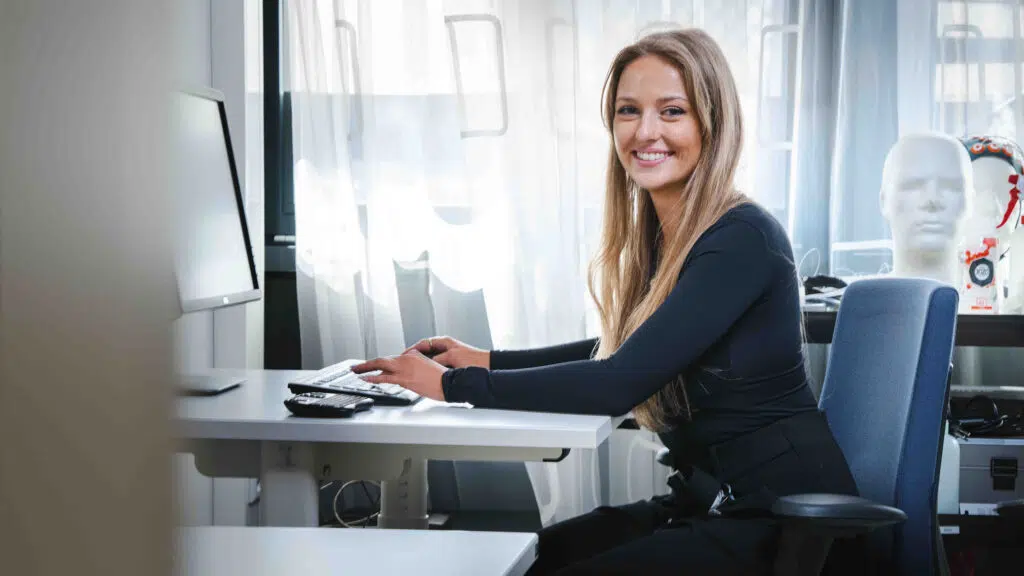
Bringing tech and people together. That’s where I want to make a difference.
Taking passengers as the starting point
One of the projects Naomi is involved in is the Flying Vision Accelerator project, which is part of the national programme Luchtvaart in Transitie (Aviation in Transition). In this project, NLR, together with partners such as TU Delft, Airbus, and KLM, is developing a roadmap for sustainable aviation by 2050. “What’s unique about this project is that we are also looking at passengers,” she explains. “How do passengers behave, and how might that change in the future? What matters to them? How can we stimulate sustainable travel habits? To answer these questions, we have set up several think tanks with professionals from industry, government, and non-profit organisations.”
“On the one hand, we believe that the government should drive change through policies and regulations. However, we also see that it is essential to bring about a shift in societal attitudes. This means the motivation for change comes from within,” Naomi continues. Although the willingness to make certain choices differs greatly per traveller, she discovered, among other things, during her research. “For example, business travellers consider the destination more important than holiday travellers, making them less sensitive to price incentives and therefore more likely to choose based on speed and efficiency. If the more sustainable option is the fastest, they are inclined to opt for it.” In addition to the types of travellers, the project also explores sustainable technological advancements in aviation and how these intersect with passenger behaviour.
“The next step is to further develop and refine various traveller personas and link them to specific measures to reduce their emissions. This will ultimately give us an overview that will enable the government and industry to determine their strategy,” she says.
Noise perception
Noise disturbance is also an important aspect for Naomi as part of her work on sustainability. A few years ago, she investigated noise disturbance caused by drones using a VR headset (virtual reality) and headphones to simulate a drone flight in a near-realistic environment. Building on this research, she conducted a study for Eve Air Mobility, a company developing electric aircraft with vertical take-off and landing capabilities (eVTOLs) in the United States, on the noise perception of their eVTOL. This is a passenger drone that can take off and land vertically, making it potentially suitable for use as an air taxi in cities in the future. “We collected data in three American cities with numerous participants. This allowed us to connect with many local people, which made the project extra special for me,” Naomi notes.
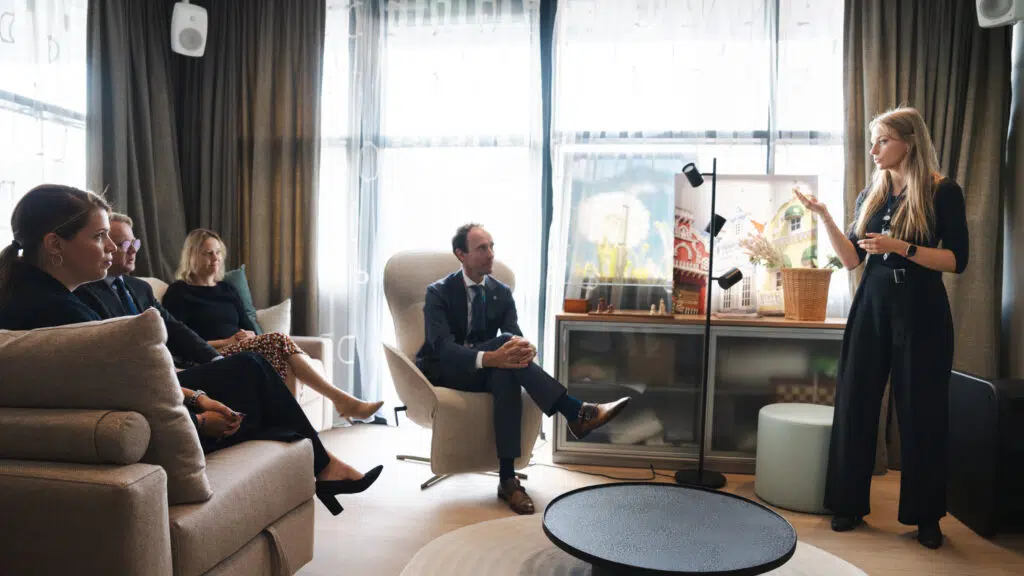
NLR offers several different methods to measure noise disturbance. “We have set up a dedicated facility called the LOUNGE, which stands for ‘Laboratorium voor Onderzoek naar Universeel Natuurlijk Gedrag en Ervaren geluid’ (Laboratory for Research into Universal Natural Behaviour and Experienced Sound). It is a living room environment where we can recreate incredibly realistic soundscapes of drones, aircraft, and jets,” she explains. For instance, she researched how noise affects people’s ability to focus on cognitive tasks. Participants were given two tasks to complete: a challenging cognitive task like a maths test, and a simpler task like colouring in a mandala drawing. “What we found was that while the level of noise disturbance was the same for both tasks, people were more prone to distraction when they were doing the more demanding task.” The findings from studies like this can ultimately be used to inform decisions about flight schedules and approach routes, with the goal of minimising disturbance for local residents.
NLR’s innovation hub
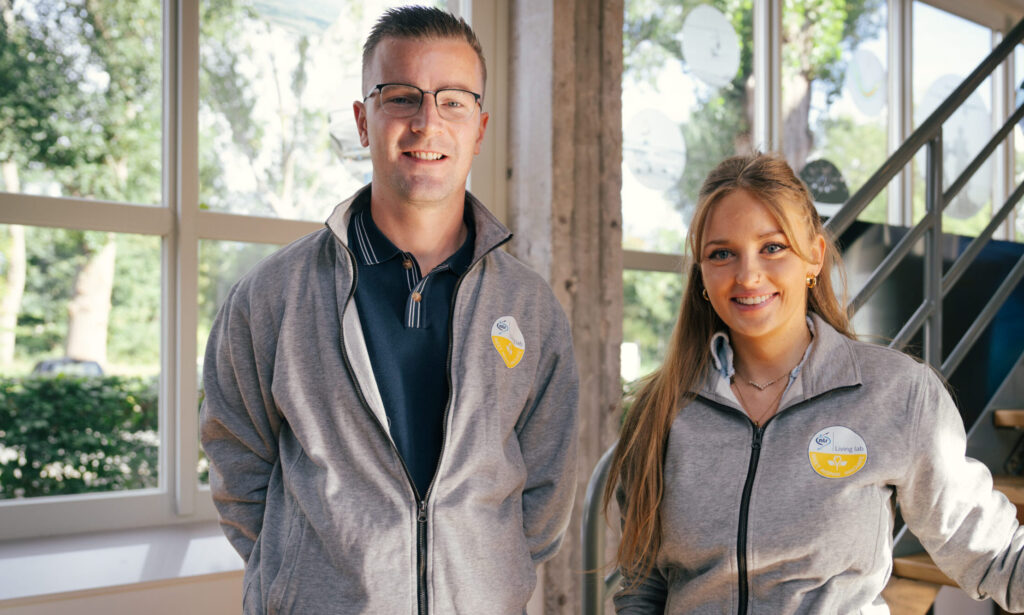
In addition to her daily responsibilities, Naomi manages the Living Lab at NLR in Amsterdam. “The Living Lab is NLR’s innovation hub. It is a collaboration and experimentation platform that focuses on innovation, connection, and interaction. Colleagues with innovative ideas or projects can come here to develop them. Here, anything goes, even matters that do not necessarily fit within NLR’s current focus and activities, as long as it’s novel,”, she explains. Companies, governments, and students can also approach the Living Lab to work together with NLR on innovations.
A prime example is NLR’s collaboration with the Brunel Foundation in creating a 3D-printed model of a hydrogen-powered aeroplane to spark children’s interest in technology and sustainable aviation. According to Naomi, “getting children excited about these developments can be challenging. A conventional presentation often isn’t engaging enough. That is why NLR and the Brunel Foundation joined forces to develop an interactive model. We can actually show kids how the propeller works using hydrogen power. The Brunel Foundation can take this model on tour to schools and exhibitions.”
The Living Lab has grown significantly over the past year. Naomi has noticed that colleagues and external parties are finding it easier to approach the Living Lab. “Last year, we launched a new programme for startups,” she says. This programme provides startups with access to NLR’s expertise and resources, such as advice on specific technical topics or facilities. “The response from both colleagues and startups has been very positive. It makes collaborating fun and uncomplicated.”
Personal growth
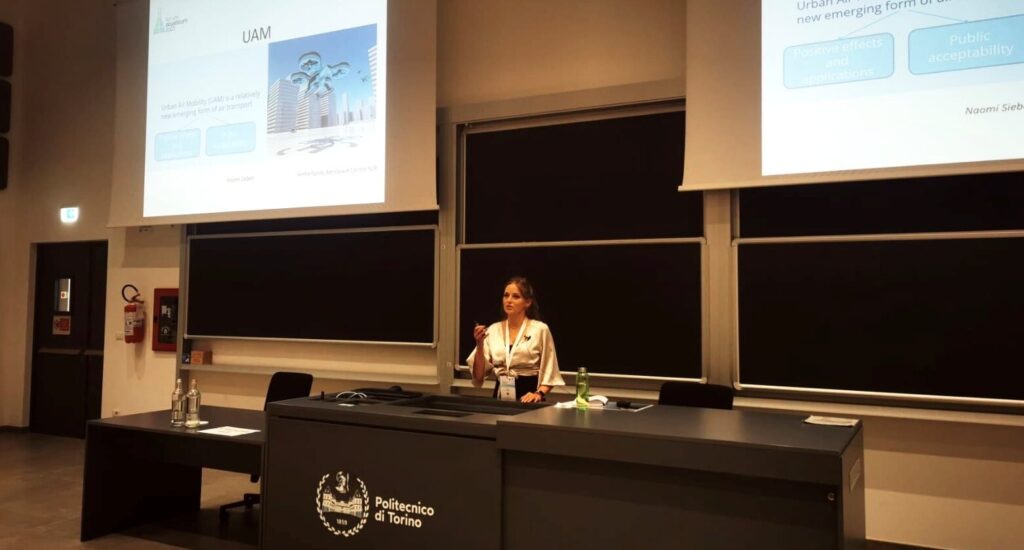
All in all, Naomi is involved in a variety of projects with different objectives, primarily aimed at making aviation more sustainable. What she is most proud of in her career so far? “That I have overcome my fear of presenting in front of large groups,” she mentions. “When I was younger, I was terrified of public speaking, like many young professionals, I believe. But as part of my role at NLR, I regularly have opportunities to present my research at conferences. At first, I would be very nervous and lie awake the night before. Over time, however, I have become more confident, and now I actually enjoy it.”
Staying engaged
Sustainability plays a significant role in Naomi’s personal life as well. She elaborates: “I try my best to live sustainably and enjoy discussing the subject with friends, such as conversations about flight shame. As someone who frequently travels by air for conferences despite working on sustainability issues, that can be conflicting at times. Nevertheless, I appreciate how my work teaches me about various aspects of sustainability, making me more mindful of my actions and inspiring me to make positive changes.”
Many of the sustainability plans Naomi is currently working on have goals set for 2050. She says: “My hope is that 30 years from now, I will still be working here and be able to see that we have achieved our sustainability objectives. While I know that we can’t single-handedly change the world, I believe it is essential that we accelerate our efforts now. Personally, I am committed to raising awareness and driving social change, so that sustainability becomes embedded in people’s thinking and behaviour.”