Programme
Climate-neutral aviation
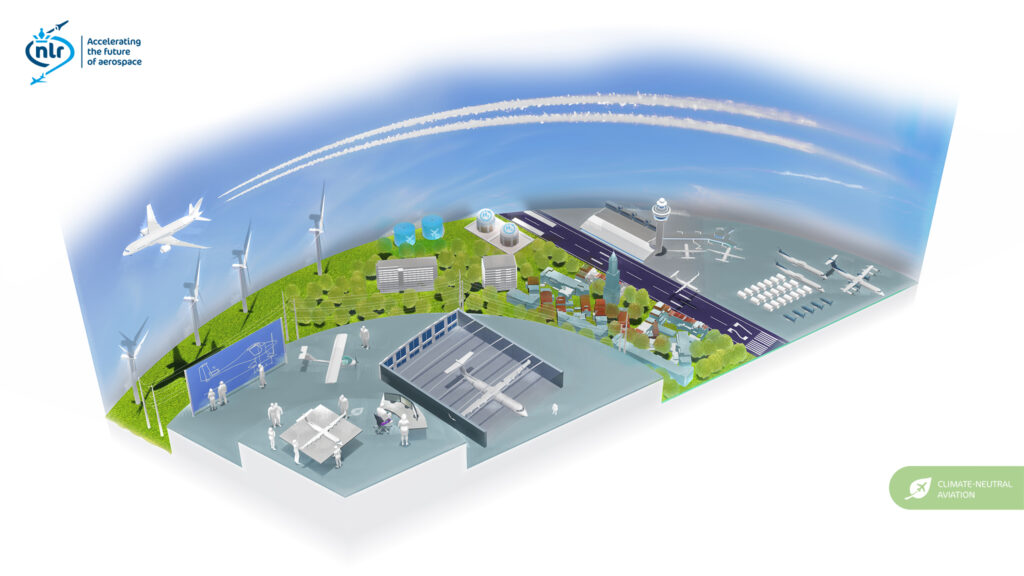
In 2050 the aviation industry, with its knowledge and economic influence, must comply with and contribute towards achieving the Dutch and European climate objectives and the United Nations’ Sustainable Development Goals. Aviation will be cleaner and quieter, thereby having less of an impact on the climate and environment.
With the programme Climate-neutral aviation, NLR contributes towards cleaner and quieter aviation. Climate neutrality requires us to take into account the entire chain of production, use and recycling of the aircraft, and to apply this within a circular economy. Moreover, the programme helps to address the societal challenge to become as robust as possible in the face of climate change, and contributes towards sustainable aviation and improving the competitive position of the Netherlands.
“Climate-neutral aviation is a complex puzzle”
Programme leader Bram Peerlings on the Climate-neutral aviation knowledge programme
To contribute towards climate neutrality of the aviation sector, this programme sets up research projects in collaboration with universities, other knowledge institutions and companies. The focus lies on (components of) propulsion technologies, sustainable fuels, testing facilities, innovative aircraft architecture, circular production and maintenance techniques, aircraft operations, regulation, certification, governmental policy and climate research.
Some projects
CICONIA
Our CICONIA project (Climate effects reduced by Innovative Concept of Operations – Needs and Impacts Assessment) aims to reduce the climate impact of air traffic. Along with stakeholders, we have examined existing climate metrics and developed a new environmental performance metric that measures both CO2 and non-CO2 emissions. Our focus is on mitigating non-CO2 effects, such as contrail formation, by developing innovative operational concepts. These concepts are thoroughly tested and documented in a report, with the goal of creating a more sustainable future for aviation.
Read more about this project on the website of SESAR.

Participation in standardisation working groups (EUROCAE, SAE)
By actively participating in various working groups, NLR builds a global network of contacts. This enables us to stay up-to-date with the latest developments. Our substantive contributions to projects in the field of airport infrastructure (such as fuel supply), hydrogen powertrain systems, cooling and cryotanks, significantly contribute to progress in these sectors. We also provide support with safety analyses, certification processes, ground test facilities and aircraft maintenance, with a focus on circularity. The storage standards of WG80 (AS6679 and AS7373) are nearly ready for release. AS7141 (hydrogen propulsion) is expected to be released in 2026.

Groeifonds Luchtvaart in Transitie: Hydrogen Optimisation and Testing (HOT)
NLR is collaborating with Fokker Next Gen on the design, development, and testing of systems for the F120H aircraft, focusing on efficient storage, distribution, and propulsion of liquid hydrogen. Our focus is on ground testing with the hydrogen fuel system, developing an advanced fuel system controller, and supporting certification processes with safety analyses, to realise a more sustainable aviation industry with innovative and safe hydrogen systems.
Read more about this project on the Luchtvaart in Transitie website.

Discover more knowledge and technology
Research infrastructure
Areas of expertise