Programme
Space for defence and society
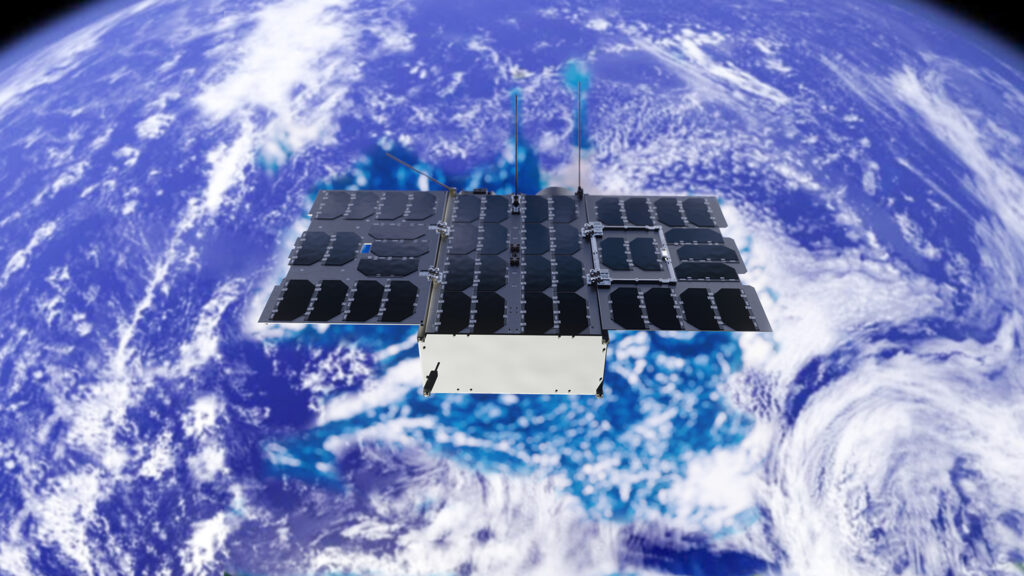
The space domain plays a crucial role in our daily lives. We rely on satellite data for communication, navigation, monitoring of vital infrastructure, and secure payment transactions. Autonomous access to space data and, consequently, access to space is of strategic importance for the economy and safety of the Netherlands and Europe. Due to geopolitical, economic, and technological developments, space applications are increasingly used as impactful solutions for societal and operational challenges. Since 2019, NATO (North Atlantic Treaty Organisation) has recognised space as a military domain, leading countries, including the Netherlands, to expand their military space capabilities.
NLR is an expert in various space-related fields, particularly at the technical component and system level and their integration. NLR aligns with the priorities set by the Dutch government in the Long-term Space Agenda (LTR). Our goal is to contribute to the safe and sustainable use of space, thereby ensuring the prosperity, knowledge position, and safety of the Netherlands and Europe, both now and in the future.
“Our goal is to contribute to a safe and secure, and sustainable use of space”
Programme leader Rik Bosma on the Space for defence and society knowledge programme
Satellites are invisible from Earth, yet they play a significant role in our daily lives. In fact, they are indispensable. Without space technology, our economy, and safety and security would be at risk. Therefore, NLR has initiated the knowledge programme Space for defence and society by the end of 2025. Programme leader Rik Bosma explains the programme.

Some projects
TRISTAN KDT JU: Secure and Reliable processing using RISC-V
Our project focuses on developing safe and reliable RISC-V processors for use in spacecraft. We are investigating the effectiveness of redundancy as a means of making processors reliable, taking into account the impact on power and performance. Through radiation testing, including a Heavy-Ion test at CERN, provided by the RADNEXT EU programme, we determine which measures truly contribute to reliability. The project aims to expand knowledge on radiation testing of electronics and will be concluded in 2026 with the processing of test results into conclusions.

Space-based Intelligence Surveillance and Reconnaissance (ISR)
Our research programme focuses on acquiring knowledge on the effective use of space-based intelligence, surveillance, and reconnaissance (ISR) capabilities. We investigate the possibilities and processes for tasking, automated data processing, timely distribution of output, and the security and integrity aspects.
ODIN’s EYE II
The ODIN’s EYE II project contributes to the development of a European Space-Based Early Warning (SBMEW) architecture initiated under EDIDP. The objective is to create a system that provides early warning against ballistic, hypersonic, and anti-satellite threats, as well as proliferation control. The project will develop a common SBMEW capability that can respond to current and future security threats.

Discover more knowledge and technology
Research infrastructure
Areas of expertise