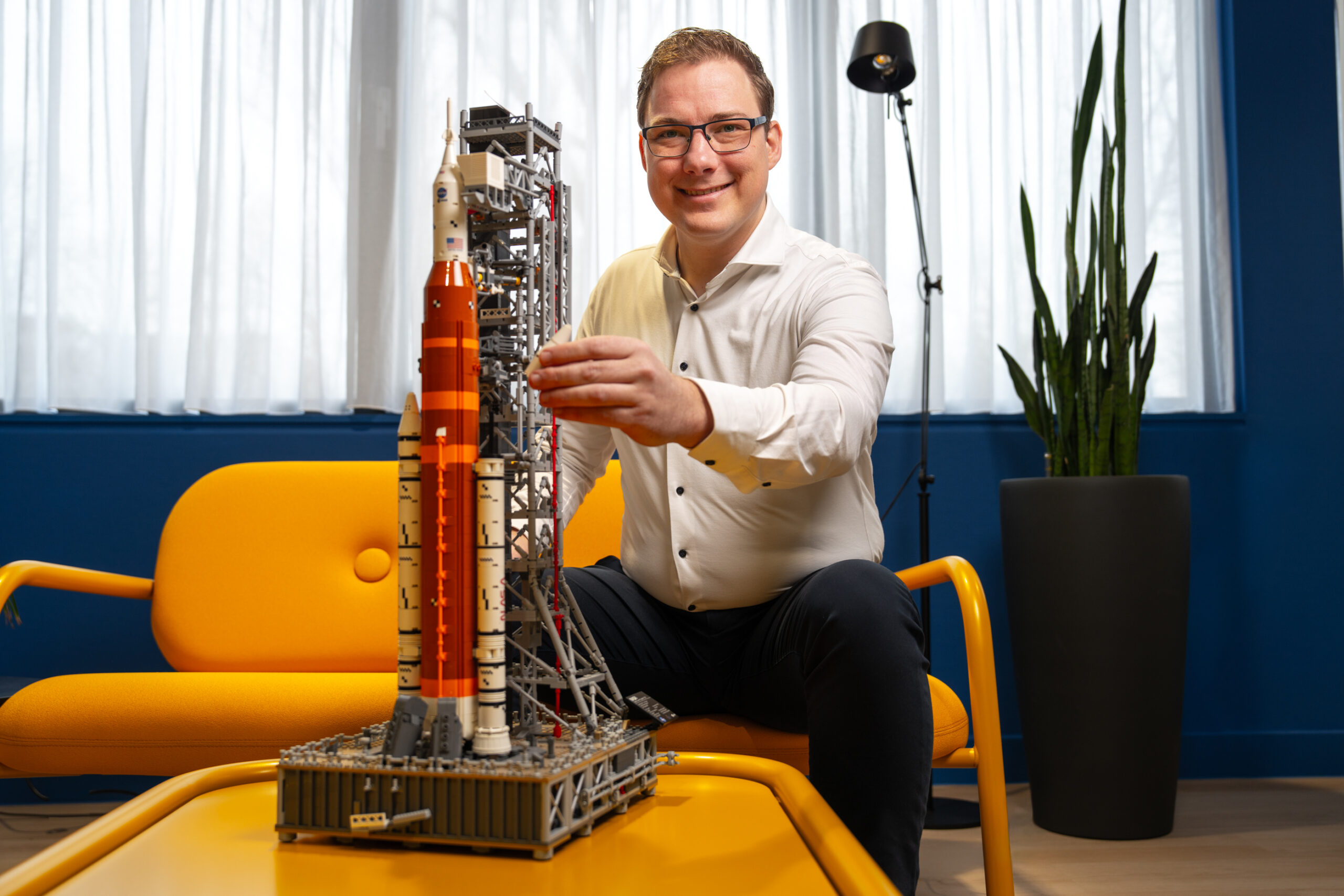
Rik Bosma is constantly looking for opportunities to make an impact on the world. His guiding principle for life is to “stand out from the crowd”. “Only then can you really be seen and make a mark.” Apart from his ambitions to make a difference, he has had a lifelong fascination with space. This is now coming together in his role as programme leader of NLR’s new knowledge programme Space for Defence and Society.
He ended up in aerospace through a detour. His career began with studies in industrial automation and computer science. “Two fields that are technically broad, ranging from mechanical to software engineering and from electrical to control engineering. So, they gave me a lot of options to explore.” Early in his career, Rik mainly worked with virtual reality, AI, and the Internet of Things. “The current hype”, he says. “I spent most of my time building demonstrators to showcase what was possible, but I wasn’t able to work on many large-scale projects with tangible results.” Looking for a role with more substance, Rik decided to apply to NLR to work on flight simulations.
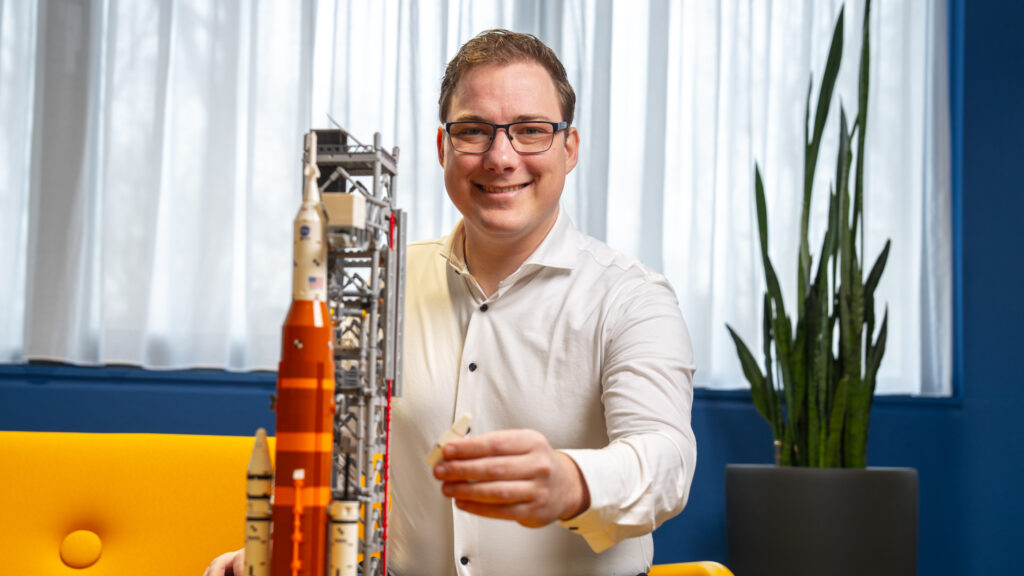
Rik has been working at NLR for over six years now and has held several positions during that time. One of his secondments was to the Ministry of Defence, where he spent two years identifying areas where innovation and collaboration could be improved. He was also involved in NLR’s Living Lab initiative, which is all about pushing the boundaries and developing new innovations outside of existing frameworks.
A new space strategy
Eventually, Rik’s career path led him to the space sector. “As space has become an increasingly vital part of our lives, it’s crucial for NLR to chart a clear course. That is why we have formed a dedicated team and have developed a new space strategy for NLR.” The strategy has now been finalised, approved, and is being implemented. One of its key components is the Space for Defence and Society knowledge programme. “Our goal is to support the Dutch government in realising its space ambitions, both from the Ministry of Economic Affairs and Defence, as well as those of commercial parties, by fostering collaboration within the ecosystem”, he explains. In doing so, we aim to ensure a safe and sustainable use of space, which will ultimately benefit the prosperity, knowledge position, and security of The Netherlands and Europe, now and in the future. One of the most important ambitions of the programme is to establish a Space Research Facility, which will focus on developing space technology and operations. A major aspect of this facility will be the design, construction, and operation of NLR’s own research satellite.
Read more about the knowledge programme Space for Defence and Society.

Proactive mindset
How has Rik managed to have so many roles in such a short time? “I’ve always taken a pragmatic approach to my work, looking at the organisation as if it were my own company. I ask myself: What is best for the organisation? How can we deliver the most value to our clients? Where are the opportunities for the future? I also take a step back from time to time and look at the world around us to consider if we are still focused on the right things. That is why I’ve taken on a range of different projects and tried my hand at various things. I’m always searching for the place where I can make the greatest contribution.”
Making your voice heard
He’s not afraid to put himself out there and enjoys discussing ideas with colleagues. “During my part-time job while I was studying, I shared an idea with my supervisor and was even given the chance to pitch it to the management team. That’s when I learned that a good idea will always find a willing listener – the only limitation is your own mindset.” Companies are always looking for innovative ideas, and NLR is no exception. Just strike up a conversation and see where it takes you. I reckon 80% of ideas might not come to fruition, but 20% have real potential. If you persevere where others give up, you will achieve results.
Setting priorities
The most memorable moment in his career was a briefing he received while he was still seconded to the Ministry of Defence, about three years ago. “A scenario was outlined about what we can expect in terms of threats from Russia, both physically and digitally. It became clear what we needed to do collectively to address these threats”, Rik recalls. “It also clarified the priorities. Protecting our country is priority number one. If we can’t do that, then all other goals – whether it’s sustainability targets or personal ambitions – are at risk.” It changed his perspective on things. “When you’re working towards a higher purpose, it’s much easier to advocate for the cause and the ideas that support it.”
The aim is to combine forces within the aerospace sector and put The Netherlands on the map as a space nation.
Building a network
Rik already has a clear vision for the new knowledge programme. “I have assembled a team of enthusiastic colleagues, and together we’re developing a space portfolio that showcases our current research projects in the field of space. This will help us identify areas where we can further develop our expertise and make informed plans for the future. Our goals are definitely ambitious. For instance, we are aiming to launch our own satellite in the near future and operate it from our own space operations centre.” Collaboration with colleagues and clients is key to this process, which is exactly what Rik enjoys doing. “It involves a bit of political savvy and strategic thinking. What do we want to achieve with our objectives? Where and how do we build a robust network? Which organisations do we want to partner with? These are all questions I’ll be exploring in the coming months.”
The ultimate goal is to establish The Netherlands as a leading space nation, both for research and economic purposes. “I think it would be amazing to create a comprehensive network of all space companies in The Netherlands, including startups that can drive innovation in the sector. By working together, we can truly make an impact.”
‘Secretly a nerd’
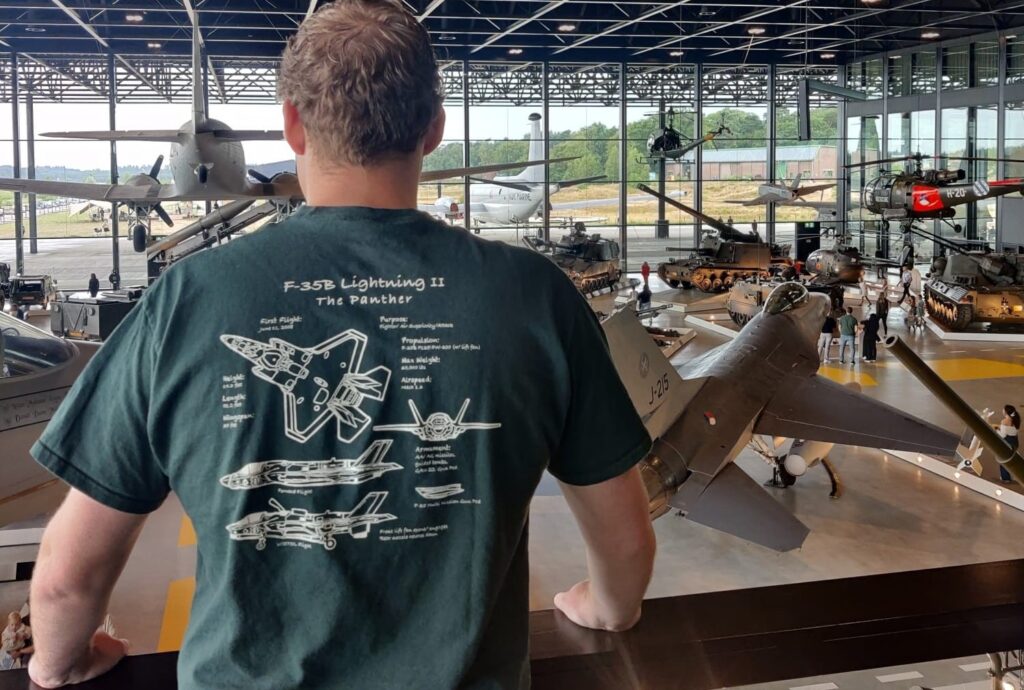
Rik is also passionate about space in his free time. “I love watching YouTube videos about astronomy, for example, with explanations about how the universe works. I find myself pondering the mysteries of gravity and wonder why we still know so little about it”, he says. “I also often use my Museum Pass. Not for art museums, but for museums that offer a more hands-on experience, like the National Military Museum or Archeon. “Secretly, I’m a bit of a nerd at heart”, he admits with a laugh.