Police partner with Smart Mobility Centre in Marknesse

1 minute read

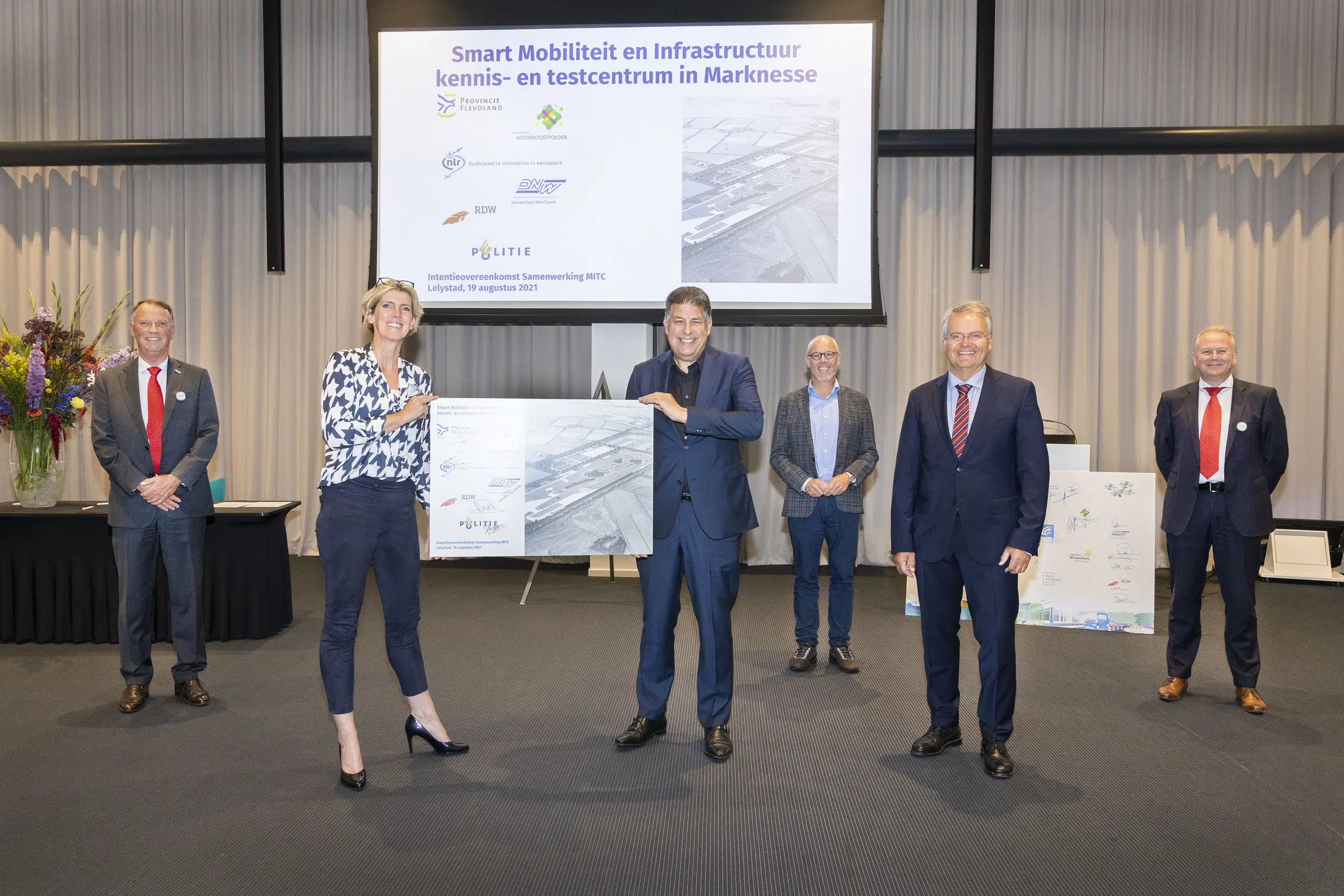
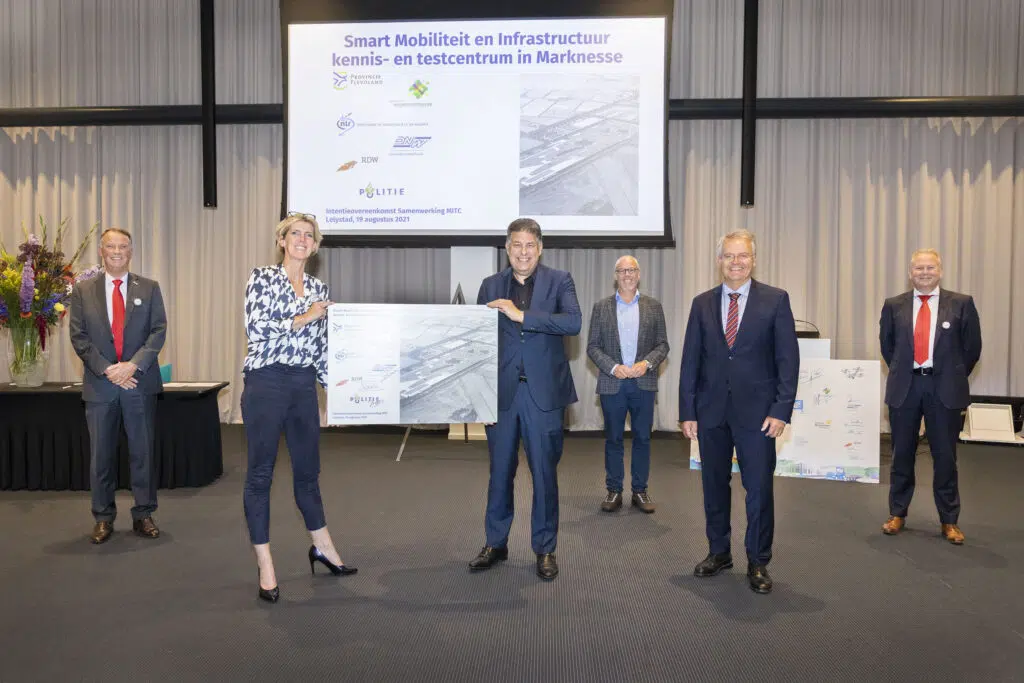
On 19 August, the police and the police academy signed an intention statement to join the Smart Mobility and Infrastructure knowledge and test centre (MITC) in Marknesse as a partner. This indicates the police's intention to relocate the Centre for Enforcement and Mobility Lelystad to the MITC and, together with NLR, DNW, and RDW, build an innovative knowledge and test centre in the field of smart mobility and infrastructure.

The close collaboration with RDW, Royal NLR, and the German-Dutch Wind Tunnels (DNW) presents a unique opportunity to make optimal use of each other’s presence, facilities, and knowledge. The parties are jointly establishing a mobility centre for testing and certifying smart multimodal mobility solutions, conducting relevant research, and sharing knowledge.

Police accession

The police are seeking a new location for the Centre for Enforcement and Mobility and are currently training in Lelystad, adjacent to the RDW site. “For the police academy, it is essential to collaborate effectively in the field of education and training related to mobility. We are already doing this at various locations in the Netherlands. We see it as a significant advantage that this is now also possible near our current location in Lelystad,” according to Gerrit den Uyl, director of the police academy.

MITC

The provision of their specific services and knowledge in the field of mobility and infrastructure at a single location makes the test facilities forward-thinking and innovative. “The MITC offers a wide range of tests and experiments with smart mobility, from development to application in daily practice. A broad range that is unparalleled in the Netherlands and even Europe, all coming together in Marknesse,” according to deputy Jan de Reus of the province of Flevoland.

(Photograph: Fotostudio Wierd)
Latest news

Sustainability and Environment

04 March 2026

Clearing the skies: why space debris demands action now

As the number of satellites in orbit grows, so does the challenge of keeping space safe and sustainable. What was once a vast and largely empty domain is rapidly becoming congested with hazardous debris. Without coordinated action, the very infrastructure that underpins modern society is at risk. The growing debris problem requires collective efforts — including the Zero Debris Charter — aimed at securing the future of space.

Safety and Human performance

16 December 2025

Cosmic radiation threatens the reliability of aircraft systems

Recently, a remarkable incident made the news: thousands of Airbus aircraft worldwide were grounded after cosmic radiation disrupted digital electronic systems. A problem long familiar in space applications is becoming increasingly relevant for aviation. Ongoing digitalisation is making modern systems more vulnerable to invisible radiation from space.

Construction and Manufacturing

28 November 2025

Unique in the EU: Modular EPTF Test Facility for Hydrogen-Powered Flight

With the opening of the Energy to Propulsion Test Facility (EPTF), NLR now operates a unique, modular test facility designed to support research. At present, the focus lies on hydrogen-electric aircraft propulsion. The new facility provides startups, SMEs and industrial partners with optimal conditions to safely and thoroughly test complex innovations in this field. In doing so, NLR contributes to accelerating aviation sustainability.