We use satellites every day, often without realising it. Satellites are essential for navigation and weather forecasting, but also for larger societal issues such as climate change research. Moreover, the military relies on satellites for secure communication. Therefore, it is crucial for NLR to continue investing in the development of new space technology. Reliable electronics play a vital role in this, for example, in the power supply of satellites, data processing, control of actuators, and receiving and transmitting data.
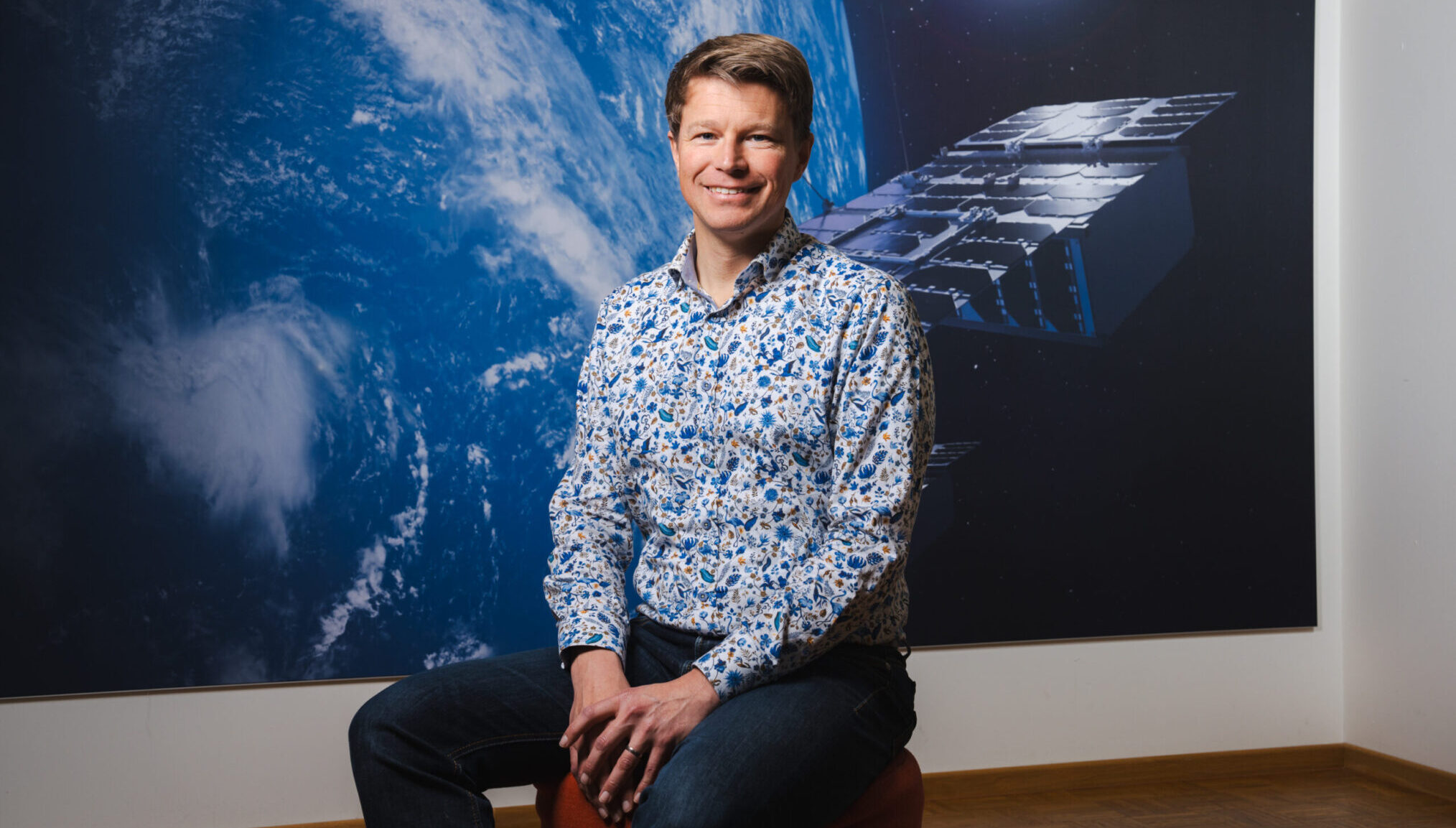
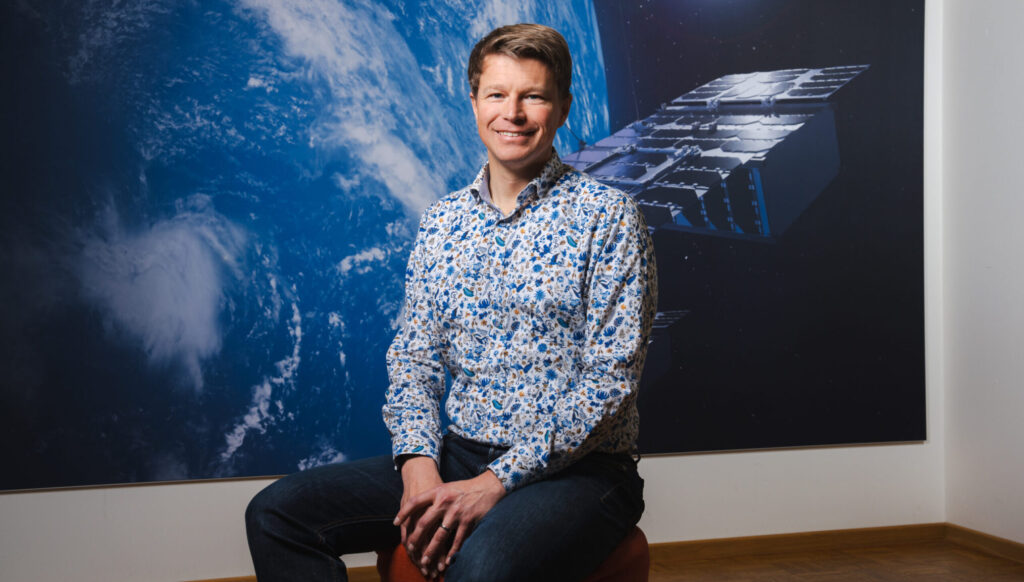
“Without reliable electronics, there can be no successful satellite operations,” says Sybren de Jong, principal engineer at NLR. He oversees various research projects on electronics in space and works on projects such as laser satellite communication, radiation research, and thermal systems for satellites. “The goal of all our research is to develop technology into mature products that can reliably operate in space.”
Thermal systems
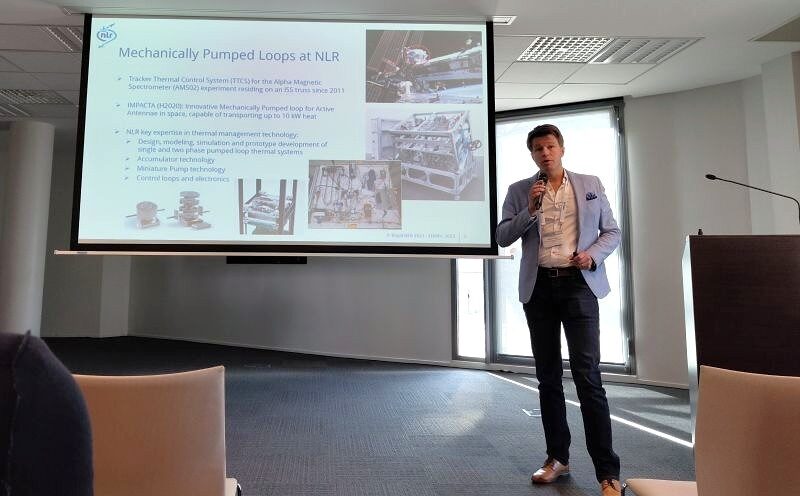
He mentions a project on thermal systems as one of the key areas of focus. Just like on Earth, electronics in a satellite can produce a lot of heat in some cases. “However, dissipating heat in space is more challenging than on Earth, as there is no surrounding air to cool it down. The only options are to dissipate heat through radiation, conduction, or using special fluids,” he explains. NLR is internationally renowned for its thermal expertise and has developed various heat transport systems for space applications. “We use an innovative pump and fluid, among others, to transport heat from the heat source to a radiator, from which it can be radiated into the vacuum of space.”
Laser satellite communication
Sybren also works on the electronics needed for laser satellite communication, which is one of the most promising developments in this field at the moment. Laser communication uses a laser beam consisting of small light pulses to transmit information. This is a necessary addition to conventional communication via radio waves, which is no longer sufficient due to the increasing amount of data that needs to be exchanged. Laser satellite communication can be used for various applications, such as communication between satellites, with Earth, or with aircraft. “We are working towards an ultimate application with a capacity of around 1 terabit per second, which is more than 100 times faster than what is currently possible with radio wave communication,” he says.
How can faster communication make a difference? De Jong mentions the detection of wildfires as an example. “Previously, it could take up to an hour for the data from the satellite to reach the end user on Earth. With laser communication, we can set up a network of satellites in space more efficiently, allowing satellite observations to reach the end user almost instantly. This is crucial in disaster response, where every minute counts.”
Fast and accurate information from space is also vital for Defence. “In the military domain, having timely intelligence is pivotal. Satellite data plays a key role in this. If you have access to the best intelligence, you also have a strategic advantage on the battlefield,” he says. In addition to faster communication, laser communication has another significant advantage: “It is more secure than radio waves because the narrower laser beam is much harder to intercept.”
Retrieving data from space faster makes all the difference
Radiation research
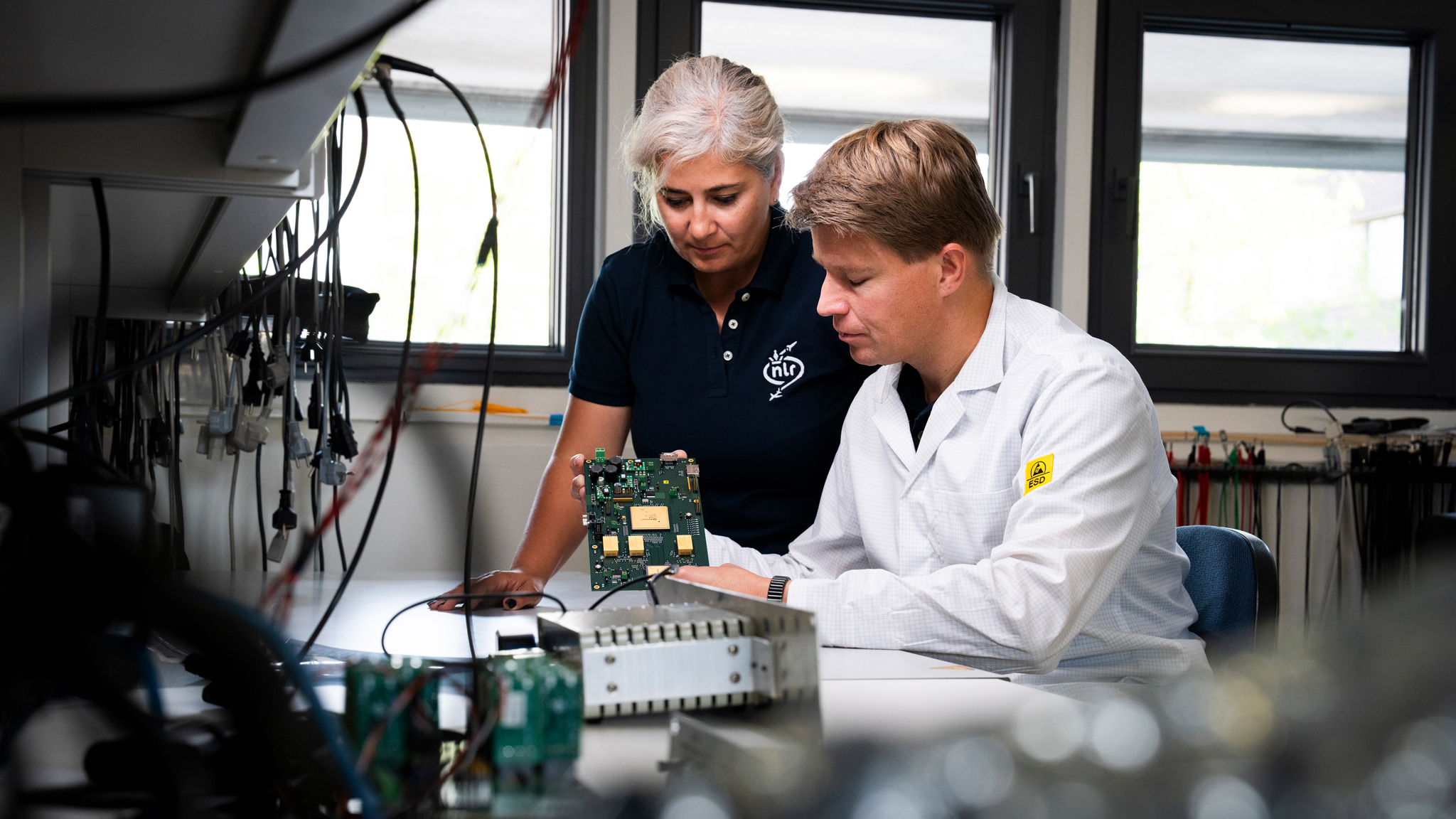
Another important area of research for Sybren is the study of radiation effects on electronics. He was involved in the European project TRISTAN. This project involved the development of a RISC-V processor (also referred to as the brain of a computer), with NLR focusing on its potential for space applications. However, not all processors can be used in space. “The radiation levels are much higher than those on Earth, which means satellite electronics need to be able to withstand that kind of radiation,” Sybren explains.
Sybren elaborates: “While we can protect electronics from weak cosmic background radiation using a layer of aluminium, for instance, high-energy particles can penetrate a satellite’s structure and alter computer bits, leading to malfunctions or even short circuits.” That is why NLR has subjected the processor developed in the TRISTAN project to both proton and heavy ion radiation tests.
Ultimately, the goal of our research is to ensure reliable space technology and a long service life for satellites. “This is essential because we are becoming increasingly dependent on space infrastructure. If satellites remain operational longer, we won’t need to launch new ones as often. I believe that is especially important because of the potential negative impact satellites have on the Earth’s atmosphere when they re-enter it at the end of their life cycle. That is why I believe we should focus on sustainable technology that lasts longer.”
Strengthening the ecosystem
Sybren notes that NLR aspires to become the Dutch centre of excellence in radiation research. “We have a wealth of knowledge in-house and are also actively pursuing new research initiatives. Moreover, industry partners are seeking us out more and more as a partner for collaborations in this area.”
He advocates for the growth of the Dutch space technology ecosystem. “Particularly for large satellites, we are always reliant on foreign players for electronics, although there are also some Dutch companies active in this field. We also have the necessary expertise in-house, which is why we need to improve our position and build up the Dutch ecosystem.” According to Sybren, this applies to both civilian and military applications.
More research
In recent years, NLR has increased its focus on space technology. When Sybren first started at the research institute six years ago, he was the only one in his department working on space electronics. Now, we have a great team dedicated to developing electronics and the necessary software for satellites. “Some colleagues join us straight from university, while others bring more practical experience to the table. I really enjoy sharing my experience with my colleagues and learning from them at the same time. It’s one of the most rewarding and valuable aspects of my job.”
He has also noticed that there is more funding available for research into space electronics in the Netherlands than before, for example from the National Growth Fund. “The funding is there for us to get on board. We need to grasp this opportunity and build on it for the future.”
Networking provides insights
Sybren was recently appointed as principal engineer, which means he is a recognised authority in his field and has a leading role in scientific research and the development of specific technologies, such as space electronics, at NLR. “I engage with many colleagues, as well as people outside the organisation, for example at conferences. It is a wonderful way to gather new ideas and share my own insights with others. These conversations often lead to new collaborative projects between NLR and companies or other research institutes, which helps to strengthen the network around NLR.”
Passion for technology, nature, and society
His work presently encompasses a wide range of responsibilities, but his heart still lies with technology. “I’ve had a passion for electronics since I was a child, which is why I love spending my free time working on electronics and other technical projects.” He also spends a lot of time with his children, exploring nature or visiting the beach – which is just a short walk from his home. “It’s a great way to spend time with my family and unwind.” Alongside his demanding job and family commitments, Sybren is also dedicated to making a positive impact in his community. That is why he serves as chair of the local neighbourhood association. “It is my way of contributing to the local community and help build connections between people.”
Into space
What are Sybren’s professional aspirations? After more than 20 years, NLR is once again developing a satellite, but this time NLR will also be handling its operations. “I think it’s essential for us to have and operate our own satellite, so we can conduct independent research and apply it – both within NLR and in collaboration with partners. Additionally, it will provide us with valuable insights about all aspects of space systems, including satellite operation. The details of this endeavour are still being worked out. “I for one am very excited to be part of this development and to see how our R&D activities are contributing to the growth of the Dutch space ecosystem in the field of electronics.”