Technology Base and Royal NLR commit to Twente Airport for innovative and sustainable aviation

2 minutes read

Technology Base Business Campus and Royal NLR are intensifying their cooperation to further develop opportunities at Twente Airport as a test and innovation airport. On behalf of NLR and Technology Base, in January two contracts have been signed that start to implement this. This involves a multi-year lease for office and work space on behalf of NLR and a cooperation contract giving Twente Airport access to NLR's premium knowledge and expertise. Both parties view the opportunities that the transition in aviation offers Twente Airport as contributing to sustainable aviation.

NLR research airplane at Twente Airport

Aviation needs to reinvent itself to be climate-neutral by 2050. This requires innovation in all aspects of aviation and calls for extensive experimentation and test programmes that in all likelihood cannot be carried out at regular busy airports. Twente Airport can offer this space due to the absence of scheduled flights. But that is not the only reason. The ideal spacious location of the airport and the available infrastructure are also reasons for Technology Base and NLR to join forces and ramp up this exchange of knowledge.

Jan Schuring, director of Technology Base and acting director of Twente Airport, explains the added value: ‘Our airport can assume a central role in the Netherlands as the incubator for the sustainability of national and international aviation, which is needed now more than ever before.’

Key role in innovation and testing

NLR carries out test programmes for various clients and is therefore the ideal, reliable partner for Technology Base to convert opportunities into results. Conversely, NLR sees the opportunities offered by Twente Airport. ‘The well-maintained and long take-off and landing strip, the large open space, the existing infrastructure, the airspace and above all its strategic location make Twente Airport unique in the Netherlands,’ says NLR’s Business Manager, Roland Slager. ‘The testing, validation and certification of, for example, new forms of transport such as Urban Air Mobility, improved aerodynamic forms, innovative materials, alternative types of propulsion, as well as new ground infrastructure and flight procedures, as was recently carried out at Twente Airport for the DREAMS project with approach flights, can all be effectively implemented at the airport. The combination of such a unique airport and the companies already located on the high-tech business park in the east of the Netherlands opens up prospects for NLR in the future.’

Twente Airport is working on its future

After a loss-making 2020, Twente Airport used 2021 to draw up realistic future prospects with positive operations. NLR is playing an important role in this. Together, these and other opportunities are currently being devised and will be presented to the Technology Base board in March 2022.
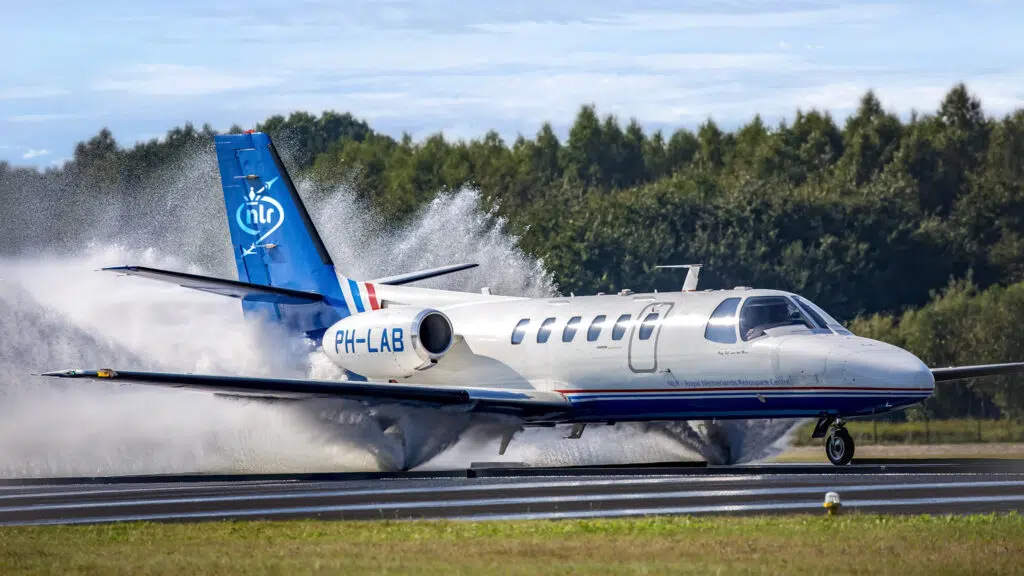
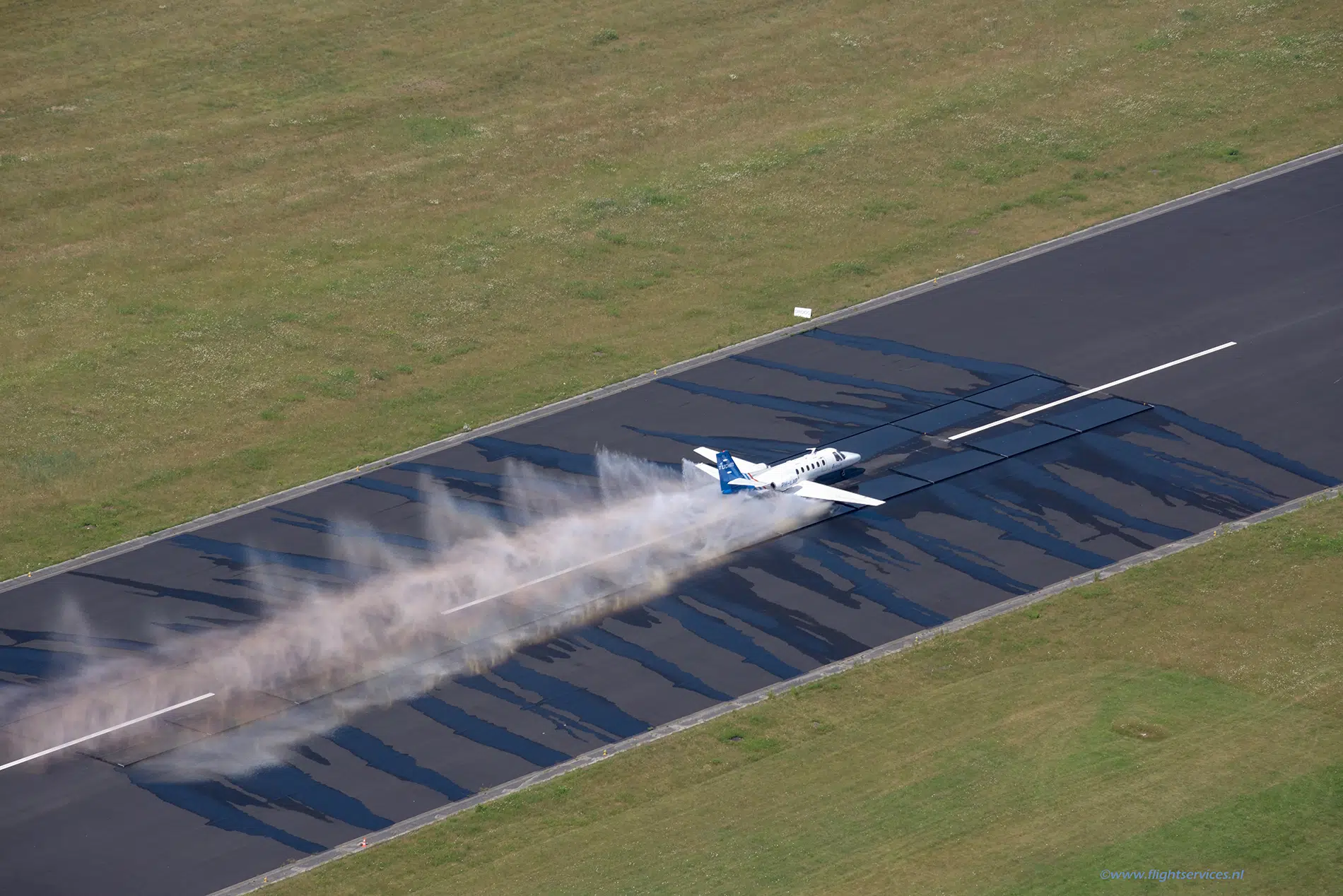
In the past, NLR conducted brake tests on a wet runway at Twente Airport. The PH-LAB tested how the brakes of an aircraft react after heavy rainfall.

For more information contact:

Latest news

Sustainability and Environment

04 March 2026

Clearing the skies: why space debris demands action now

As the number of satellites in orbit grows, so does the challenge of keeping space safe and sustainable. What was once a vast and largely empty domain is rapidly becoming congested with hazardous debris. Without coordinated action, the very infrastructure that underpins modern society is at risk. The growing debris problem requires collective efforts — including the Zero Debris Charter — aimed at securing the future of space.

Safety and Human performance

16 December 2025

Cosmic radiation threatens the reliability of aircraft systems

Recently, a remarkable incident made the news: thousands of Airbus aircraft worldwide were grounded after cosmic radiation disrupted digital electronic systems. A problem long familiar in space applications is becoming increasingly relevant for aviation. Ongoing digitalisation is making modern systems more vulnerable to invisible radiation from space.

Construction and Manufacturing

28 November 2025

Unique in the EU: Modular EPTF Test Facility for Hydrogen-Powered Flight

With the opening of the Energy to Propulsion Test Facility (EPTF), NLR now operates a unique, modular test facility designed to support research. At present, the focus lies on hydrogen-electric aircraft propulsion. The new facility provides startups, SMEs and industrial partners with optimal conditions to safely and thoroughly test complex innovations in this field. In doing so, NLR contributes to accelerating aviation sustainability.