Super space challenges with the ISS
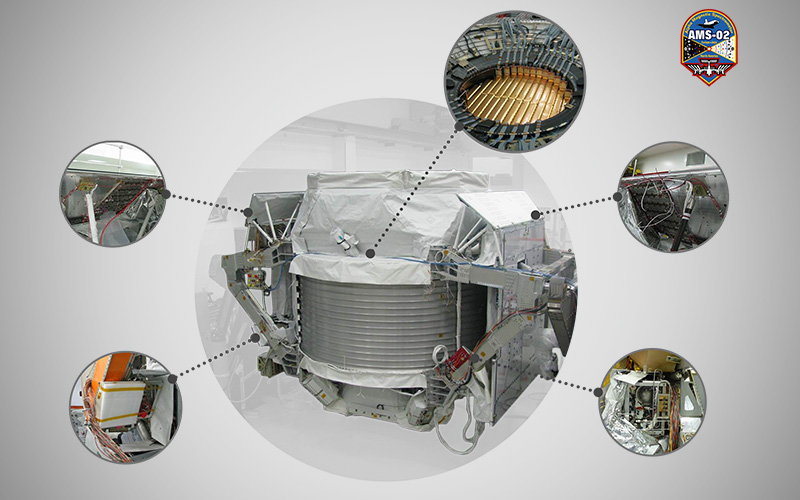
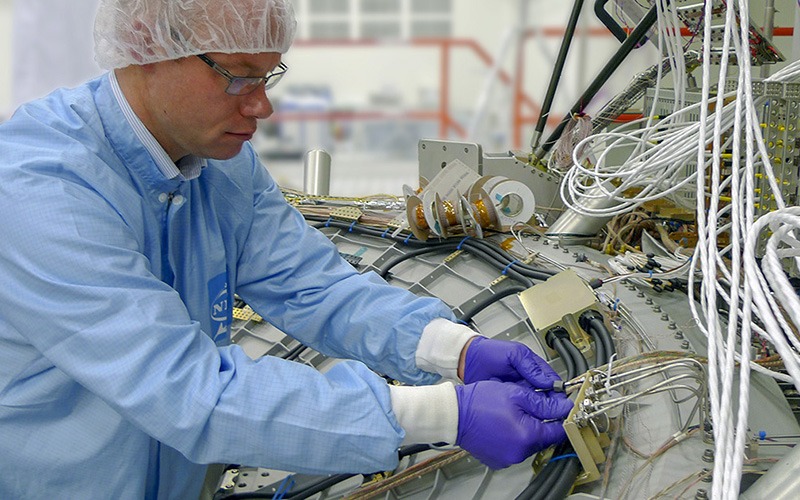
One of the proudest moments for NLR and for Johannes van Es personally was contributing to the Alpha Magnetic Spectrometer (AMS-02), the largest experiment ever to run on the International Space Station (ISS), in 2011. The AMS-02 detector is basically a space-based version of the particle detectors used in CERN, measuring the same kind of particles that fly around in the universe. By determining the speed and characteristics of particles that pass through the detector, scientists can study antimatter, dark matter and the age of cosmic radiation. NLR’s contribution to the AMS-02 experiment was the TTCS, or Tracker Thermal Control System, developed by Van Es leading an international team. The TTCS kept the electronics that make up the detector within a 0.2°C bandwidth, in a fluctuating thermal environment, without disrupting the magnetic field of the detector. It was achieved by implementing an innovative two-phase pumped system, using CO2 evaporation in 3mm diameter tubes. The system works so well that CERN now also uses it in three other detectors.
One hiccup in the experiment was that the bearings of the pumps were not fully adapted to CO2 as a coolant and wore out sooner. Although responsible as project manager, Van Es was unable to account for this because of US confidentiality rules covering the selected US space pump. He remembers a phone call in the middle of the night from the experiment’s chief scientist and Nobel Prize winner Samuel Ting. A solution was needed for a pump that had become stuck. Van Es, being the level-headed expert that he is, started the TTCS back-up system within half an hour to enable continuation of the AMS scientific push. The design flaw caused by the wrong bearings is still there, however, so a space walk is being prepared for 2020 to replace the pumps. Van Es takes it in his stride. “I feel bad for the astronauts. Here we can work with tiny screwdrivers and have plenty of time to put things together perfectly. But they have to get out there and work with those giant gloves in an environment where you can’t even weld!”
Practical applications: small satellites
The AMS-02 experiment underscores the importance of fundamental knowledge of thermal control in specialised environments like satellites and aircraft, and Van Es’s experience gives him an edge in devising solutions for clients, especially in the development of satellites, which are becoming more and more common. “Small satellites, in the femto and pico ranges, as well as smaller nano-scale satellites, don’t face thermal challenges due to their limited amount of on-board electronics. When we get to the upper ranges of the nanosatellites, starting at about 5kg, we start to see the need for thermal control. But their delicate nature makes normal heat pipes suboptimal, because the pipes are always ‘on’. This spells trouble for small satellites because there’s a risk of cooling down too quickly when they’re in the shade. You don’t want to lose the heat that you need for your electronics to run smoothly. Otherwise it would require integrating heavy batteries”. So Van Es and his team are developing heat pipes that switch off on command, maintaining a good working temperature for the electronics.
This case study is testament to Van Es’s entrepreneurial vision. “The future of satellites will see a shift away from the one-off, extremely well-designed units commissioned by the likes of NASA and ESA, and more towards constellations of many smaller satellites driven by demand from commercial parties,” says Van Es “Commercial parties think more in terms of low-cost and good is good enough”, he adds. “So you need to start thinking differently about thermal control, both in the way you design it and how to produce larger numbers.”
With small satellites becoming increasingly commonplace, Van Es is piloting a small and resilient pump based on a device made for medical applications. It has twenty small piezo-membrane pumps, so that if one fails you still have 19 out of 20 to maintain the flow. Van Es: “It’s a great solution that fits into many satellites, and it’s easy to produce economically in large numbers.”
Thermal control made easier by 3D metal printing
A new breakthrough in thermal control possibilities is the emergence of 3D metal printing. “In a discipline like thermal control, which relies heavily on tubing and pipes, being able to print metal is a godsend,” Van Es says. “NLR specialises in 3D metal printing, with our NLR MAMTeC facility (Metal Additive Manufacturing Tech Centre), and we possess all the required knowledge and skills. What’s more, it’s right next door to my office.
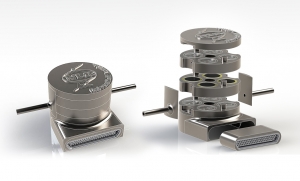
Thermal control designs used to be limited by conventional manufacturing techniques like the drilling, milling and bending of tubes, but now we can just print it, making it possible to work on a smaller scale and optimise everything.” The thermal control systems for small satellites are just one project that has benefited from this approach. “The heat exchangers can be much smaller because the channels are printable at optimum size and orientation, and the entire structure is lighter because it uses printed honeycomb structures.”
A brand new thermal control room and facilities for NLR
Van Es is proud to show his ‘two-phase demonstration loop’, a test site for all kinds of two-phase applications and elements. “As we have this setup ready, we can start testing an evaporator or accumulator within days. Our clients really appreciate our ability to test prototypes so quickly.”