Dutch Space and NLR have officially delivered the embedded training system for the F-35 Lightning II Joint Strike Fighter (JSF) to Lockheed Martin. The software product provides realistic and effective in-flight mission training for fighter pilots using virtual entities and is based on E-CATS (Embedded Combat Aircraft Training Systems). E-CATS is a joint development of Dutch Space and NLR.
Embedded Training
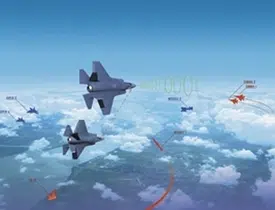
E-CATS is a training simulation system that is integrated into the operational system of a combat aircraft and provides flexible scenarios for realistic exercises. It offers pilots simulated combat situations with virtual opponents from the air and ground during their training flights. The computer-generated opponents appear on the F-35’s sensors as real threats with realistic properties. Fighter pilots can train individually (single ship ET) or as part of a team of four pilots training a combat action in a multi-ship configuration of E-CATS.
Training with the E-CATS simulation programme can take place at any desired location and time. This also makes scenarios in a relatively small airspace and over sea accessible, where the installation of ground threats is normally practically impossible.
Cost-saving
E-CATS can generate significant savings. Because fewer aircraft are needed as opponents (‘red air’) during training, fuel, manpower, and the lifespan of combat aircraft are saved. The simulation programme provides increased effectiveness per training hour and the possibility of making training more complex without further investment. Together, this can result in estimated annual savings of millions of euros. The lower need for ‘red air’ flights during training missions also reduces the environmental impact.
E-CATS, foundation for LVC
The E-CATS functionality in the F-35 provides a foundation for various air forces that are currently exploring the concept of ‘Live, Virtual, Constructive’ (LVC) training. E-CATS provides the computer-generated threat environment for LVC training configurations. With E-CATS on board, a pilot can participate in training missions within the range of an LVC training area and train anywhere and at any time, without the need for ground communication means.
Development of E-CATS
- NLR and Dutch Space have been working together since the late 1990s on the transformation of the concept into the implementation of embedded training for the Joint Strike Fighter.
- The application for a single aircraft was demonstrated in 2004 in an operational F-16 of the Royal Netherlands Air Force.
- In 2007, a multi-ship demonstration at Lockheed Martin provided insight into the technical maturity and additional benefits of embedded training for multiple aircraft. With multi-ship embedded training, multiple pilots can exercise during flight within a shared tactical environment. To implement the application, each aircraft is equipped with a computer system with E-CATS software. E-CATS uses an existing data link to guarantee the same tactical picture for each aircraft.
- In early 2009, Dutch Space and NLR received the green light from Lockheed Martin for the implementation of the embedded training system E-CATS in the F-35.