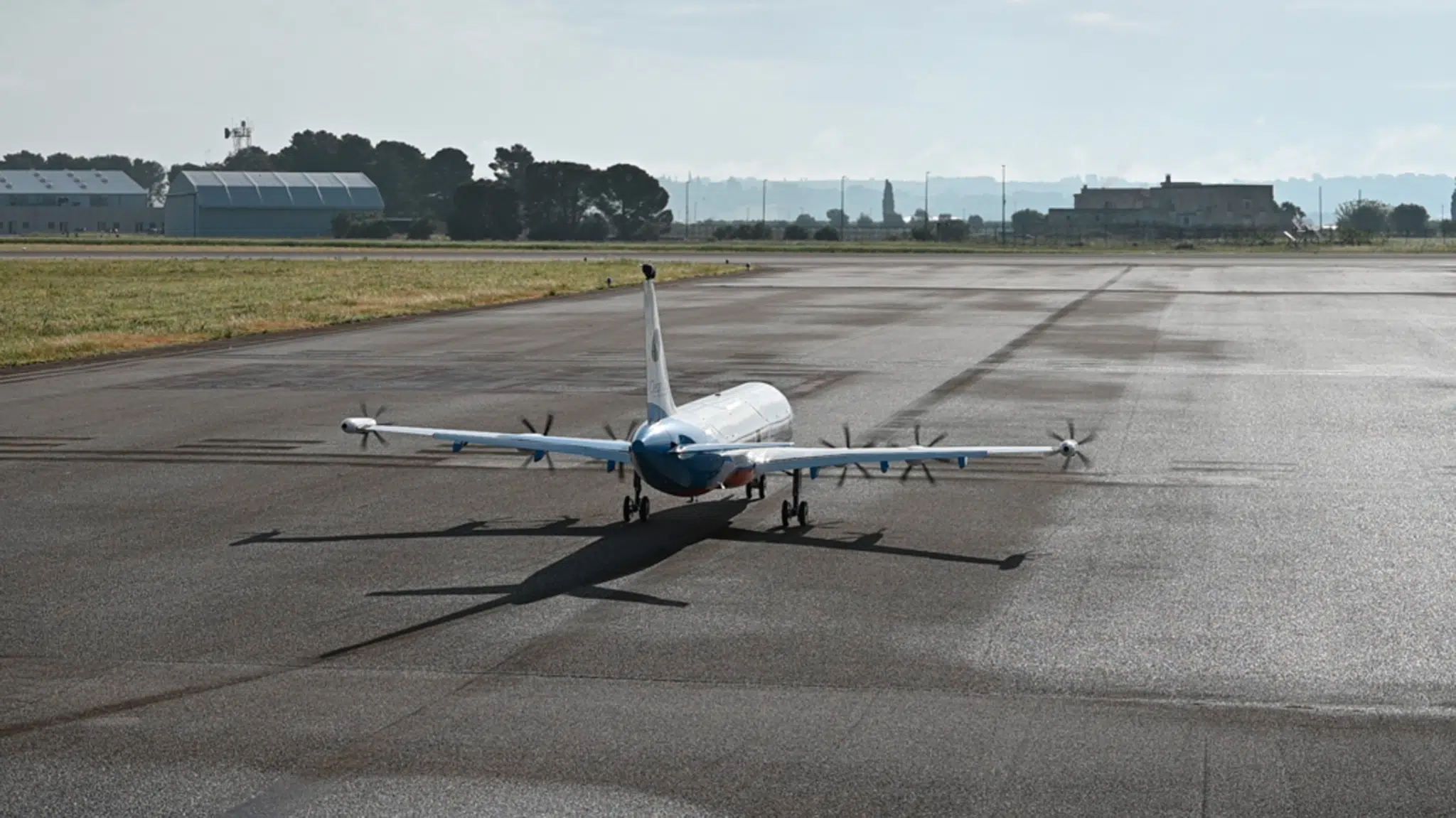
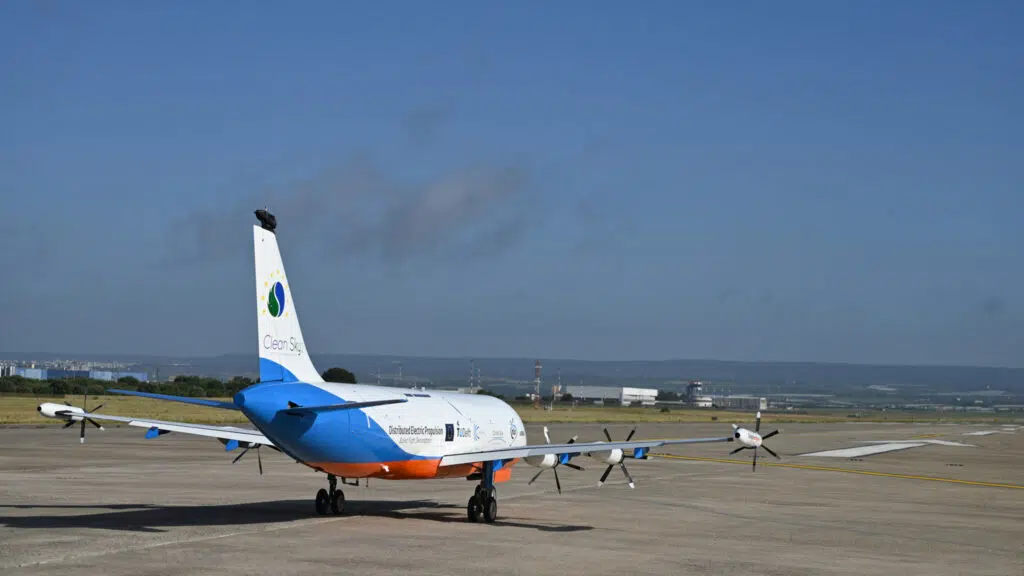
A scaled model of a new configuration aircraft with distributed electric propulsion (DEP) successfully completed its maiden flight from Aeroporto di Taranto-Grottaglie in the south of Italy. The aircraft with a wingspan of 4 metres, a take-off mass of 167 kg, and a cruise speed of 100 knots, took off, completed a 10-minute flight, including an approach just over the runway, and landed successfully. Subsequent flights will aim to qualify the aircraft for measurement flights, during which dynamic manoeuvres will be executed. Through these efforts, we shall learn about the feasibility to harvest the benefits of DEP technology for large passenger aircraft.
The scaled model flight in Italy was conducted by Royal NLR – Netherlands Aerospace Centre, with the aircraft being remotely controlled. The pilot commands the aircraft from a ground-based ‘cockpit’, aided by a tail-mounted camera providing visual feedback alongside instrument readings to guide navigation.
The objective of the flight is to explore the potential of DEP technology for the application in large passenger aircraft using less energy in a flight. The scaled flight testing will focus on the dynamic aspects of the technology. Questions to be addressed include: Which control algorithms yield the most significant benefits? Can the aircraft be effectively controlled through differential thrust on the propulsors, and how does the aircraft respond dynamically to external stimuli? These inquiries will be thoroughly examined throughout the flight test campaign.
Objective
Within the European Programme Clean Sky 2, a collaborative effort involving industry, universities, and research centres aims to mature disruptive technologies that will enable significant reductions in energy consumption. The European civil aviation sector has committed to achieving a climate-neutral air transportation system by 2050, and distributed electric propulsion can contribute to that. Large passenger aircraft with DEP can fly missions with more than a 20% reduction in current average energy consumption using the technology as has been calculated in the Clean Sky 2 programme, making the propulsion much more efficient. To reduce the risk and cost of the development of such an innovative technology the scaled flight testing technique is applied.
Looking back
The scaled flight test investigations are built on an earlier development validating the scaled flight test methodology. To accelerate technology maturation, first the Large Passenger Aircraft (LPA) Innovative Aircraft Demonstration Platform (IADP) within the European Clean Aviation programme subjected an aircraft to multiple automated manoeuvres as a viable and competitive test mean to investigate aircraft behaviour. For this demonstration, a partnership between Airbus, CIRA, Royal NLR, supported by Orange Aerospace and ONERA as coordinator built, tested in the wind tunnel and flight tested the Scaled Flight Demonstrator (SFD) in 2022. This dynamically scaled version, at 1:8.5 scale, of a typical large passenger aircraft featured a wingspan of 4 metres, a take-off mass of 140 kg, and a cruise speed of 85 knots, powered by two jet engines running on regular jet fuel.
During previous flight tests an accurate flight test instrumentation system measured the scaled aircraft flight parameters. Results of the scaled flight testing have been compared with full-scale test results which validates the value of the scaled flight testing methodology. The instrumentation is also used in the DEP flight tests.
Following this successful campaign, the aircraft was rebuilt and transformed into a new configuration powered by a battery pack and equipped with six propellers, constituting the so-called DEP technology. Last year in May unfortunately the DEP-SFD caught fire during ground tests conducted at the NLR premises in Amsterdam. Despite the setback, the project partners remained resolute and viewed the incident as a valuable learning experience. A redesign (first tested in a ground test facility and subsequently incorporated into the aircraft during ground tests) eventually resulted in the current model that now flew successfully for its first time.
Demonstrating resilience, unwavering commitment, and a steadfast focus on the objective, the partners look forward to the further flight tests with the DEP-SFD and the flight test results.
Partners of the project are Airbus, NLR, ONERA, CIRA and TU Delft supported by Orange Aerospace.
This project has received funding from the Clean Sky 2 Joint Undertaking (JU) under grant agreement No 945583—GAM-2020-LPA. The JU receives support from the European Union’s Horizon 2020 research and innovation program and the Clean Sky 2 JU members other than the Union.