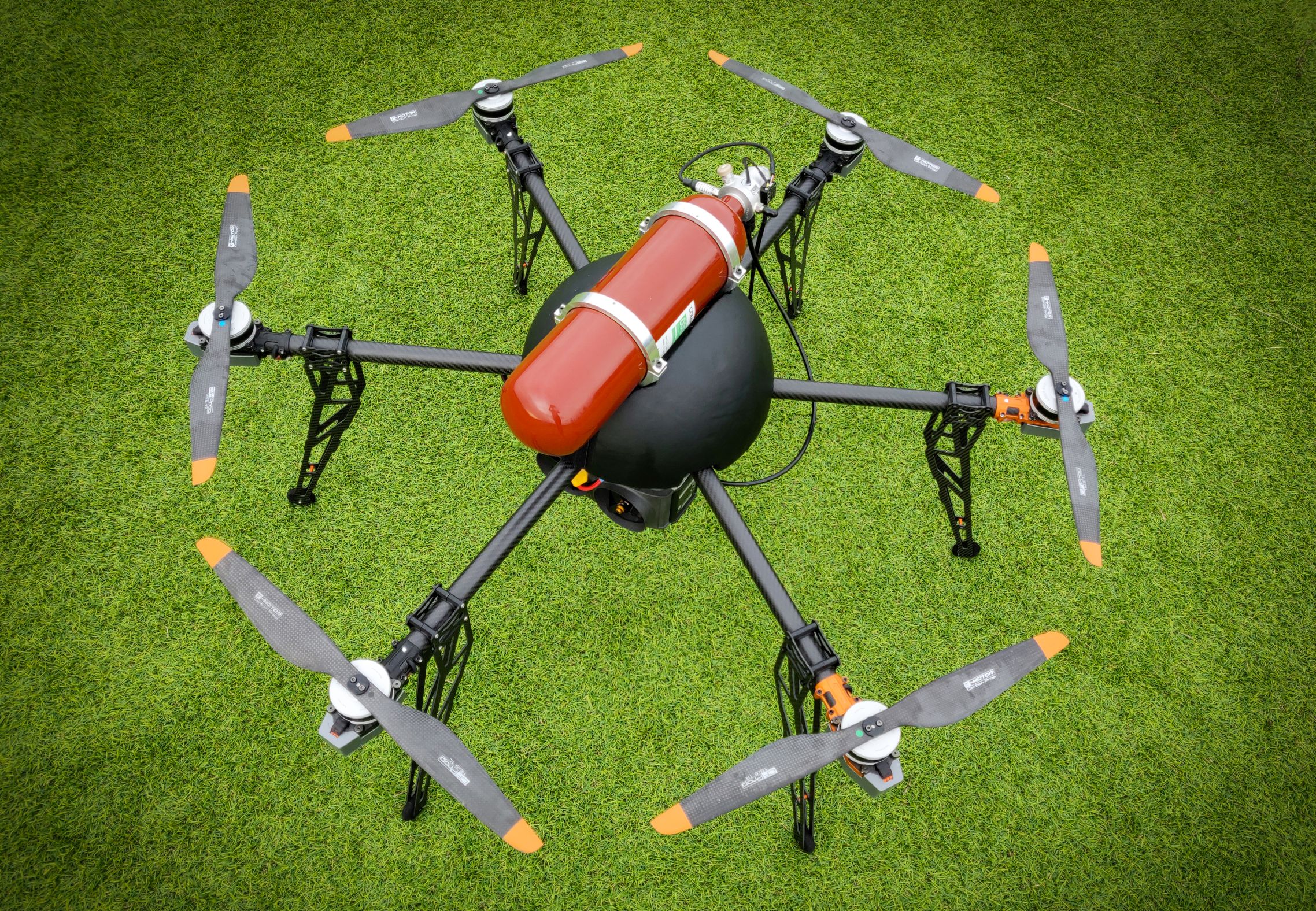
At the test centre in Marknesse, the Royal Netherlands Aerospace Centre (NLR) has flown a hydrogen-powered drone in the airspace. This Dutch premiere in the open air provides additional insights into the research and development of alternative fuels for sustainable aviation.
Martin Nagelsmit, programme manager for Electric Flying: “The drone has a power output of 2 kW. The next planned step to fly on hydrogen is significantly larger: 15 kW. Ultimately, NLR aims for aviation to be emission-free by 2070. Hydrogen propulsion can play a major role in this. We are making this possible for drones first. Furthermore, we are taking a concrete step towards fulfilling the agreements made by the aviation sector in the ‘Smart & Sustainable’ plan to reduce CO2 emissions by 35% by 2030 and the agreements in the draft agreement for sustainable aviation.”
After conducting various tests, NLR will share its findings with other parties so that they can also carry out flights in the short term. For example, the Royal Netherlands Navy is working on developing a hydrogen-powered drone for flights over the sea, and due to close collaboration with DroneHub Groningen Airport Eelde, their drone will soon be able to be inspected by NLR.
Flying on hydrogen
This first flight involved a drone – formally known as a Remotely Piloted Aircraft System (RPAS) – weighing eight kilograms with six propellers and equipped with a high-pressure tank (300 bar) of two litres filled with hydrogen gas. The tank is connected to a fuel cell that initiates an electrochemical process. In this process, hydrogen is combined with oxygen from the air to produce electrical energy. This enables the drone to fly in a (locally) CO2-neutral manner. The only by-product is water vapour. Another significant advantage of hydrogen is that the drone can fly for a considerably longer period with a full tank than with just a battery.
Safe drone flying
In principle, only aircraft and pilots that meet all legal requirements are allowed to fly in Dutch airspace. NLR established the Netherlands RPAS Test Centre (NRTC) in late 2015 with broader authorities: its own airspace with the necessary permits and exemptions to fly prototypes that do not yet meet all requirements. The airspace and ground area are closed territories. The hydrogen-powered drone has been experimentally certified, and NLR pilots are allowed to fly it without a ‘Special Airworthiness Certificate’ (S-BvL).
A thorough safety analysis has led to the drone being equipped with a backup for the hydrogen propulsion. In the event of power loss, a battery can automatically kick in. The drone can then continue flying and land safely.
For more information, visit our website about the Drone Centre.