NLR introduces the Trim Excitation Device for precise wind tunnel testing

2 minutes read

Recently, NLR has taken a significant step in the development of innovative technologies for the aerospace industry. With the introduction of a Trim Excitation Device (TED), we are taking a next step in the precision and accuracy of wind tunnel testing for tiltrotor aircraft. The development contributes to NLR's ambition to be an innovation leader in the field of wind tunnel testing.

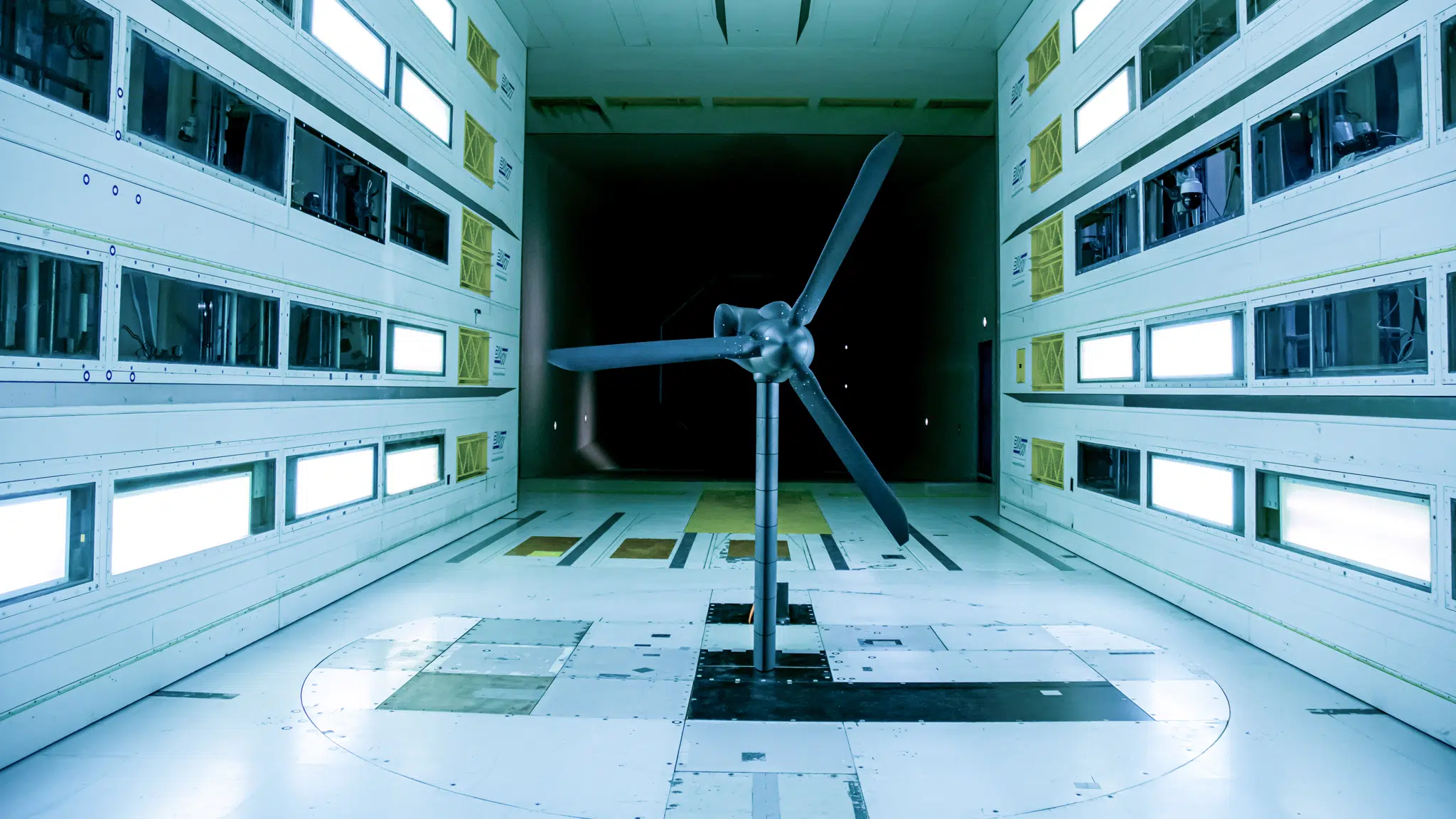
ATTILA tiltrotor whirl flutter shakedown test in DNW LLF.

One of the main drivers behind improving the design of a tiltrotor is the aeroelastic instability characterised by strongly coupled wing-rotor movements, also known as whirl flutter. This phenomenon generally limits the maximum speed that the aircraft can achieve.

Wind tunnel testing helps to understand and improve these sorts of aerodynamic properties of an aircraft. By means of scale models and wind tunnel testing, engineers can simulate and optimise the performance of an aircraft.

Reliable and precise testing

TED is an advanced device consisting of three main components: the trim (the offset), the excitation (the frequency), and the amplitude (the displacement). Since these three components are independent of each other, TED can be adapted to the specific excitation needs of each aeroelastic rotor model. This provides TED with a reliable and precise method to test and optimise flight performances under specific conditions.

The device has a robust gear system and an integrated blade spring mechanism, allowing for precise amplitude control. Furthermore, TED can simulate a wide frequency range of 1 to 25 hertz, enabling it to replicate a wide range of realistic scenarios. This enables our clients to perform tests such as whirl flutter, which can optimise flight performances.

Patent

For TED, which was developed for the ATTILA project (Advanced Testbed for TILtrotor Aeroelastics), a patent application was recently submitted with success and has now been granted in both Europe and the US. The patent enables NLR to continue utilising and valorising the unique technology behind TED in the future. With this technology and patent, NLR profiles itself as the strategic partner in the development and testing of advanced (tilt)rotor systems. This strengthens our position in the aerospace industry and contributes to the development of innovative aerospace technologies.
Read more about the patent.

Latest news

NLR corporate

18 June 2026

Fifty years of German-Dutch Wind Tunnels: a success story of European cooperation

On 18 June 2026, a milestone is celebrated in the Noordoostpolder, an area of the Netherlands reclaimed from the sea. The German-Dutch Wind Tunnels (DNW), a collaboration between the German and Dutch research organisations DLR and NLR, will have been in existence for fifty years. During this time, DNW has grown into a leading organisation for aerodynamic and aeroacoustic experiments for research institutes and industry worldwide.

Sustainability and Environment

03 June 2026

NLR and TU Delft link simulation models in new lab focused on climate-neutral aviation

How do you make an entire aviation system more sustainable, rather than just a single flight or a single aircraft? That is what Royal NLR – Netherlands Aerospace Centre – and TU Delft are investigating in the newly established Dutch Aviation Systems Analysis Lab. Last week, the organisations demonstrated connecting their simulation models for the first time. An important step towards being able to find the answers to tomorrow’s questions.

Defence and Security

08 May 2026

NLR-Marknesse host of NATO exercise TIE26

From 12 to 22 May, NLR-Marknesse will serve as the host location for NATO's annual exercise dedicated to improving drone counter-measures. During this event, military personnel, tech experts, and innovators from across the Alliance will gather in the Noordoostpolder for a counter-drone exercise.