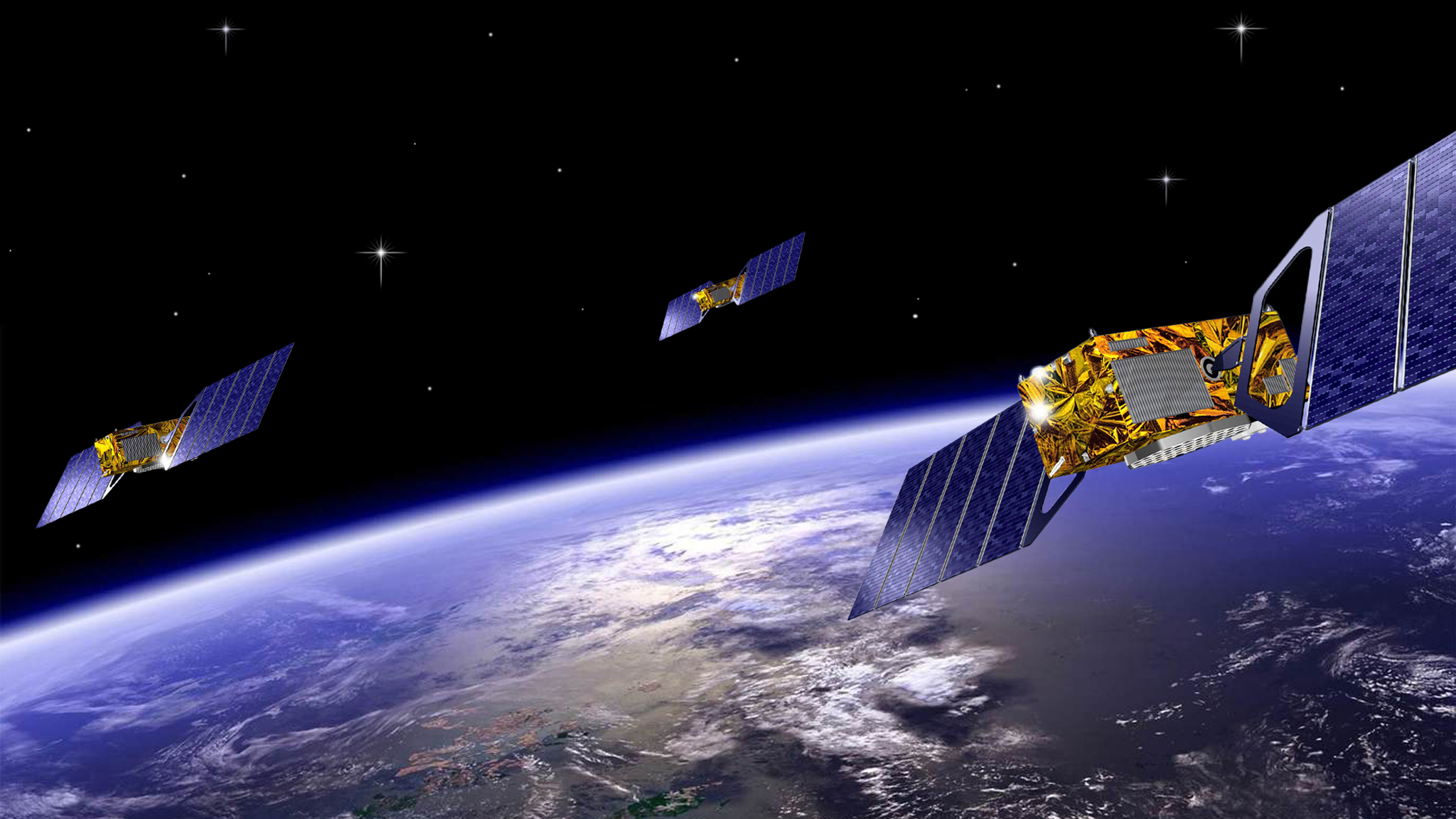
At an altitude of 350 kilometres or higher we encounter many small satellites these days. Those that belong to one collective contribute to the same mission, ideally in an autonomous way. Such collaborative constellations can provide numerous advantages compared to the traditional bigger satellites that – most of the time – operate on their own. For instance the revisit times can be reduced drastically and they have the benefit to deal with gradual degradation (if one small satellite fails, the other in the constellation can take over). Also tasks can be shared as some of them can be dedicated to measurements, while others can communicate data to earth.
“Both types of functionality ask for intelligent solutions”, states NLR Vice President Aerospace Systems Mark van Venrooij. “Together with the industry NLR aims to develop key technologies for small satellites and their constellations. This is where both Dutch parties can strengthen each other: the expertise and knowledge of NLR combined with the hands-on know-how and experience of Hyperion”.
Bert Monna, CEO of Hyperion, fully agrees: “At Hyperion, we like exploring products that do not exist yet and for this we strongly believe in co-engineering with partners such as NLR. Together we want to develop a hardware platform for modern, high-performance computing, as well as solutions to bottlenecks in communication, for example deployable antennas for small satellites.”
High-performance computing
Small satellites use more and more high-resolution sensors, but have, on the other hand, a limited downlink capacity due to constraints because of their small size. Progress in low-power on-board computers however enables more sophisticated processing in the satellite itself. So, preferably not all data but only processed and relevant information is sent to Earth. New computational techniques are very promising for helping to achieve these objectives. Hyperion and NLR will join forces in the ambition to develop these solutions, hardware and software, for small satellites.
Deployable antennas and higher frequencies
“For the desired bandwidth antennas need to be big enough. Available volume during launch is very limited though. This means that antennas for small satellites need to be deployable in a smart way. Together Hyperion and NLR want to develop such antennas including supporting electronics”, explains Van Venrooij. According Monna the complexity also relates to the radio communication. “Another approach is the usage of frequencies in the X-band or Ku-band. A lot of research still needs to be done. Therefore, once more: the collaboration of NLR and Hyperion is a good next step in this mutual exploration”.

About Hyperion Technologies
Hyperion Technologies is an independent Dutch space company located in Delft, Netherlands. Having been active since 2013, it specialises in the development of miniaturised, high-performance and smart components for small satellites as well as satellite platforms for complete missions. This includes both hardware and software. Hyperion follows the philosophy to provide the best-in-class products to its clients worldwide, scratching at the limits of the physically possible within the scope of miniaturisation.
The company leverages to a large extent on the availability of COTS components. High robustness, reliability and testing are the leading principles. Hyperion believes that it is only a matter of time until the SmallSat market matures to a level where high standards with regards to reliability and robustness will apply for small satellites.