By: Elise Scheers
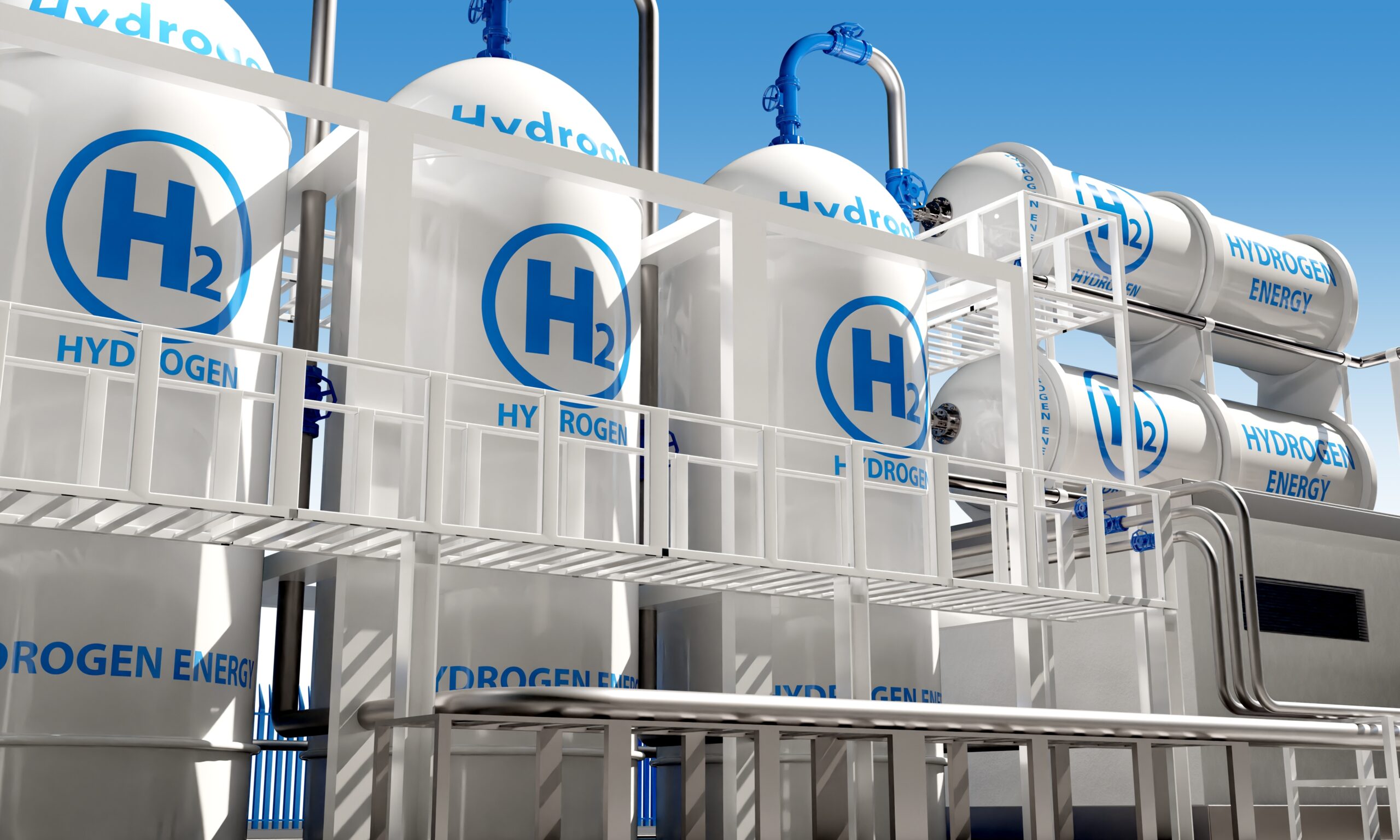
Hydrogen has a special role to play in making aviation more sustainable. Liquid hydrogen is widely regarded in this sector as one of the most promising solutions for climate-neutral aviation. Researchers at universities and companies are busy developing hydrogen-powered airplanes.
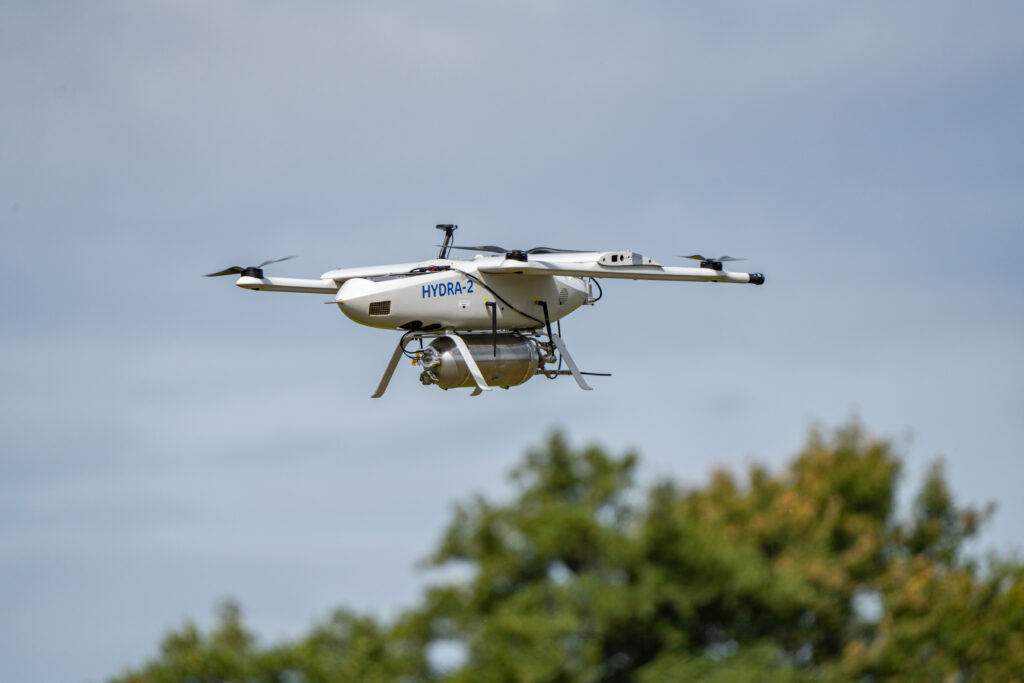
At NLR itself, we’re also working on it. Recently, colleagues carried out a test flight with a hydrogen-powered drone (see the image below).
Report
Download the report by Elise Scheers and Jilles Andringa: ‘Promising First Deployments of Hydrogen-powered Aircraft Operations in the European Commercial Flight Network‘.
But what’s sometimes forgotten is that there is a lot that needs to be done on the ground, too, if we’re really going to be able to fly hydrogen-powered aircraft in a few years. Airports should have dedicated infrastructure for the storage, distribution and refuelling of liquid hydrogen. This requires, among other things, special storage tanks, pipes and tank facilities. And all of this infrastructure has to comply with the highest safety standards.
Although hydrogen-powered aircraft are not yet on the market, I can already see a chicken-and-egg problem looming: I fear that airports will not be quick to invest in this hydrogen infrastructure as long as there are hardly any hydrogen-powered aircraft using it. Conversely, airlines will be reluctant to invest in hydrogen planes if they are not sure that they can refuel at a sufficient number of airports.
Taking the lead
I expect the ‘hydrogen era’ in aviation will start with just a few airports taking the lead (this is also expected by Airbus), who will be the first to build the infrastructure for hydrogen. But which European airports are best suited for this?
That’s what I am investigating, along with Jilles Andringa and other colleagues from the Royal Netherlands Aerospace Centre (NLR). To be precise, we want to know: which connections between two European airports are most favourable for hydrogen flights?
To tackle this, we have developed a method for systematically comparing pairs of European airports. We then ranked these pairs of airports according to their suitability for the use of hydrogen-powered aircraft. For our analysis, we compiled a list of ten assessment criteria. These include the suitability of the type of flights for hydrogen aircraft, the proximity of hydrogen infrastructure, the available space at airports, the availability of renewable energy, and the involvement of airports and airlines in hydrogen developments. We then assessed thousands of European airport pairs against these criteria.

Ranking
This results in a ranking (which you can find in our report) that shows which airport pairs are most suitable to be the first to be equipped for hydrogen flights. To test our approach, we analysed the years 2035 and 2040. Around these years, the first hydrogen-powered aircraft are expected, from, for example, Airbus.
More reading
In our research, we used aircraft concepts from the TRANSCEND project (Transdisciplinary methods for societal impact assessment and impact creation for security research technologies), for which we had available performance estimates for these years.
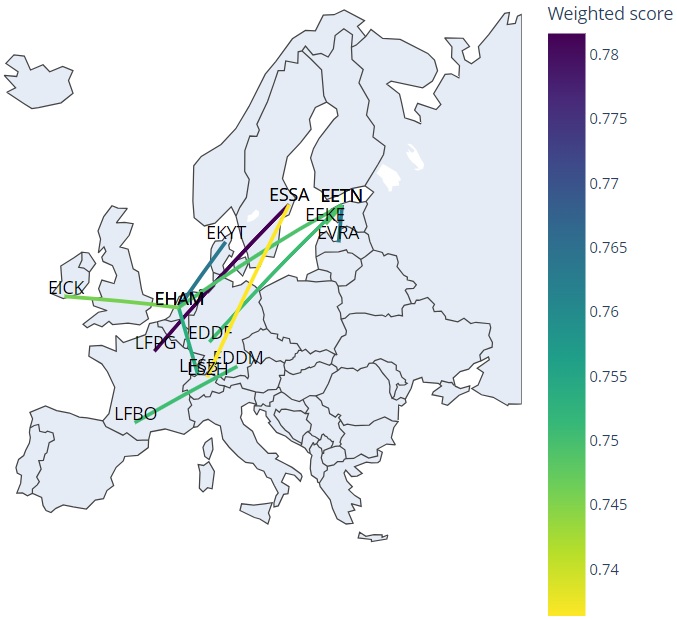
In the ranking of suitable airport pairs for the year 2035, Stockholm Arlanda – Paris Charles de Gaulle emerged as the most promising airport pair. For the year 2040, the Tallinn-Riga route finished at the top of the ranking. In addition, the many connections from and to Amsterdam Schiphol stood out, which in both years were prominently represented in the top ten (see figure below).
It is important to note, however, that these airport pairs did not top the rankings because of one decisive characteristic. Their position is the result of a combination of factors. Key factors included the alignment of existing flight schedules with the performance of hydrogen-powered aircraft and the impact of hydrogen-powered flights on passenger volumes. And also, the scores of the highest-ranked airport pairs are very close to one another.
The computational model that we have developed is modular. That means we can easily extend it or modify it with new insights. This includes, for example, the later addition of new types of hydrogen aeroplanes or the inclusion of additional assessment criteria and the updating of the analysis based on new data. This means that our approach will continue to be useful in the future.
Will you help me with the next step?
I think the analyses we have done so far are an important first step. They demonstrate that the methodology is working and can provide insight into which airport pairs are likely to lead to the introduction of hydrogen flights. At the same time, we used only publicly available information and literature for the study. Therefore, it is quite possible that we have not yet taken into account all the factors that are relevant for airports, airlines or other parties in the hydrogen chain.
So I see this study as a starting point, and I would like to make a call: are you working on hydrogen in aviation, for example, at an airport, an airline or a company in the hydrogen chain? Then I would like to talk to you. E-mail me at: elise.scheers@nlr.nl. With additional knowledge, practical experience and data, we can further refine our methodology and together hopefully arrive at new insights.
Why this research is important
With this research, my colleagues and I are contributing to more sustainable ways of flying. At the same time, for many people, flying on hydrogen still feels like something from the distant future. Many of the current pilot projects still focus on ground operations. These are important first steps, but ultimately, of course, we also want to gain experience with actual hydrogen flights.
I think we have reached a point where we need to move towards actual test flights. Of course, these must be done safely, but I think we should create more space to experiment and gain experience with hydrogen in real operational conditions. This will require more than just technological progress. Governments can also help by creating space for demonstration projects and test programmes. I hope that our research can contribute to this next step: not only providing insight into where hydrogen-powered flights hold promise, but also helping stakeholders to make more informed choices regarding the first practical applications.
About Elise
Elise Scheers studied aerospace engineering at TU Delft; she did both her bachelor’s and master’s degrees. During her master’s degree, she focused on aircraft design with alternative propulsion, for example with engines that draw their energy from hydrogen or batteries. Since 2023 she works at the Royal Netherlands Aerospace Centre in Amsterdam. Within the Sustainability team, she is researching adaptations to airport infrastructure for future hydrogen-powered or electric aircraft. She also uses life-cycle analyses to map the environmental impact of aviation fuels and technologies.
Knowledge Programme
This research is part of the NLR Knowledge Programme on climate neutral aviation. Want to know more about hydrogen? This booklet lists several NLR research projects on hydrogen as an energy carrier.
Photo: Shutterstock