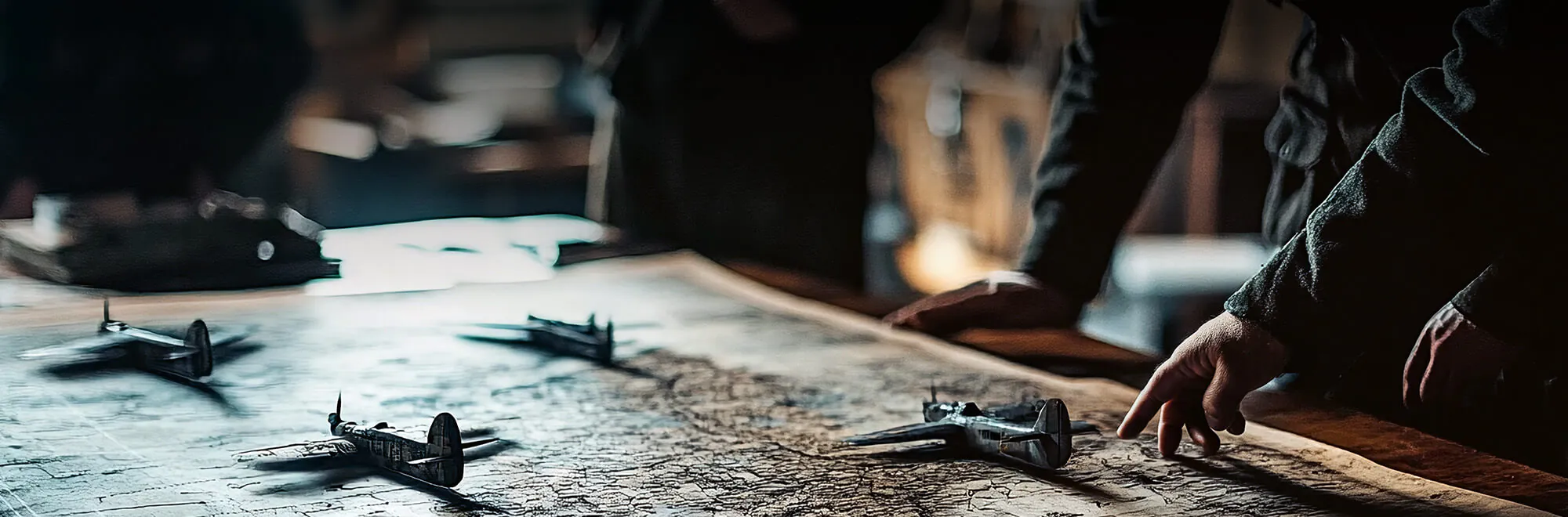
The idea is far from new. During World War II, the Women’s Royal Naval Service – the Wrens – used chalk and bed sheets to simulate convoy movements and submarine attacks. This simple exercise led to the development of new tactics and procedures that made Atlantic supply lines safer. It demonstrates that wargames do not have to be expensive, complicated simulations to have a significant impact.
From secure environment to strategic capability development
Wargaming is a serious game in which participants make strategic choices. It can involve tabletop exercises, board games, digital simulations, or a mix of these, sometimes even with AI support. The difference from other methods lies in the human element: making dynamic decisions, experimenting, and learning from mistakes.
For future force design, this is crucial. It involves translating strategic ideas into concrete capability development. This makes it clear for planners what the interplay is between complex systems, different domains, and human decision-making chains. They help expose assumptions, discover hidden vulnerabilities, and explore new possibilities.
Enhancing adaptive capability
However, wargaming is not an exact science. It shows which situations and reactions are plausible, but does not guarantee specific outcomes. Biases from designers or participants, as well as preparation, can influence the results. Therefore, it works best in low-threshold formats that allow for rapid repetition and iteration. It can also be enhanced with digital tools or AI for specific ‘deep dives’. Diversity among participants and scenarios based on real data increase the value and applicability of the insights gained.
The real value of wargaming lies in learning through experience. Often, the most important lessons come from failure: the ‘losing’ team discovers weak points that lead to more robust and flexible structures. So, it’s not about winning, but about fostering critical thinking, exposing risks, and enhancing adaptive capability.
Interested in how wargaming works in modern force design, including the recent Dutch-JAPCC initiative for a repeatable approach within NATO? The full article is available via JAPCC.