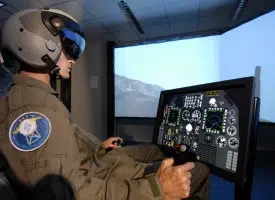
This year’s edition will be held from 1 to 5 December in Orlando, Florida. NLR’s activities at I/ITSEC 2014 will include a special Smart Bandits demonstration.The Smart Bandits project was commissioned by the Royal Netherlands Air Force and sought to answer the following question: Which technologies are available for presenting human behaviour in simulated aerial combat, and how can we apply these technologies to create intelligent virtual opponents? The four-year project was concluded in 2013 with a demonstration at NLR’s Fighter 4-Ship facility, where team mission training scenarios can be tested. During the demonstration, four manned Fighter 4-Ship F-16s engaged in combat with four Smart Bandits in a simulated environment above the North Sea. The results showed that the fighter pilots rated the behaviour of their opponents as realistic.
Virtual opponents are also called Computer Generated Forces (CGF) and have been deployed in tactical simulations for some time. One innovative aspect of the Smart Bandits project is the way NLR designed the behaviour of the opponent agents to include typical aspects of human behaviour like team coordination, tactical capabilities, and cognition. This produced Smart Bandits that are truly challenging adversaries. They can launch autonomous attacks, make plans, take measures to protect themselves, in short, they behave much as human opponents would.
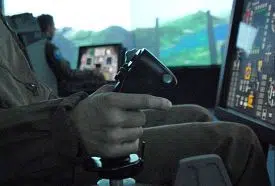
Smart Bandits can be used to conduct effective and cost-efficient training exercises. Using a simulator means that no expensive aircraft need to take to the skies. Nevertheless, training in a simulator can still be quite costly. Many support staff are needed to direct and control the virtual opponents. The Smart Bandits developed by NLR can operate autonomously without human direction.
Smart Bandits is a software program that can be used to model the behaviour of virtual opponents, and can be purchased under licence. Users can deploy this tool to create their own virtual opponent models and incorporate these into simulation systems. At I/ITSEC, NLR expects to generate considerable interest in this innovative, effective and cost-efficient training module among armed forces as well as manufacturers and users of simulation systems.