With the SME Defence call 2025, Holland High Tech is challenging entrepreneurs to develop, together with research organisations, innovative projects for dual-use applications within strategic areas identified by Defence.
In the very first SME Defence call, eleven SMEs and their projects were selected for grants. NLR is involved in three of them.
The high-tech sector makes a major contribution to the economic position of the Netherlands in the world. Through Holland High Tech, the government joins forces with companies, knowledge institutes and governments to make a crucial contribution to solving societal challenges. One of NLR’s objectives is to help and support Dutch small and medium-sized enterprises (SMEs). Implementing research projects with SMEs is one of the ways to do this.
The following three NLR projects were recently awarded:
Radiation-resistant chips for space
When a satellite goes into space, the semiconductors on it must be radiation-resistant. The problem is that half of the special radiation-resistant chips in European satellites now come from non-European suppliers. Risks include: potential supply chain delays and – in defence applications – potential undesirable dependencies.
In this context, the RASSS (Radiation Assured Semiconductors for Strategic Autonomy) project was set up by NLR and the company Spherical Systems. In the workflow, the design of the special rugged chip must move to the first design phase; this is even before decisions have been made about the layout of the chip or the production method. This should lead to a faster design process. The project will involve only European partners in the design and manufacture of the chip. So the whole supply chain stays in Europe.
Rocket engine
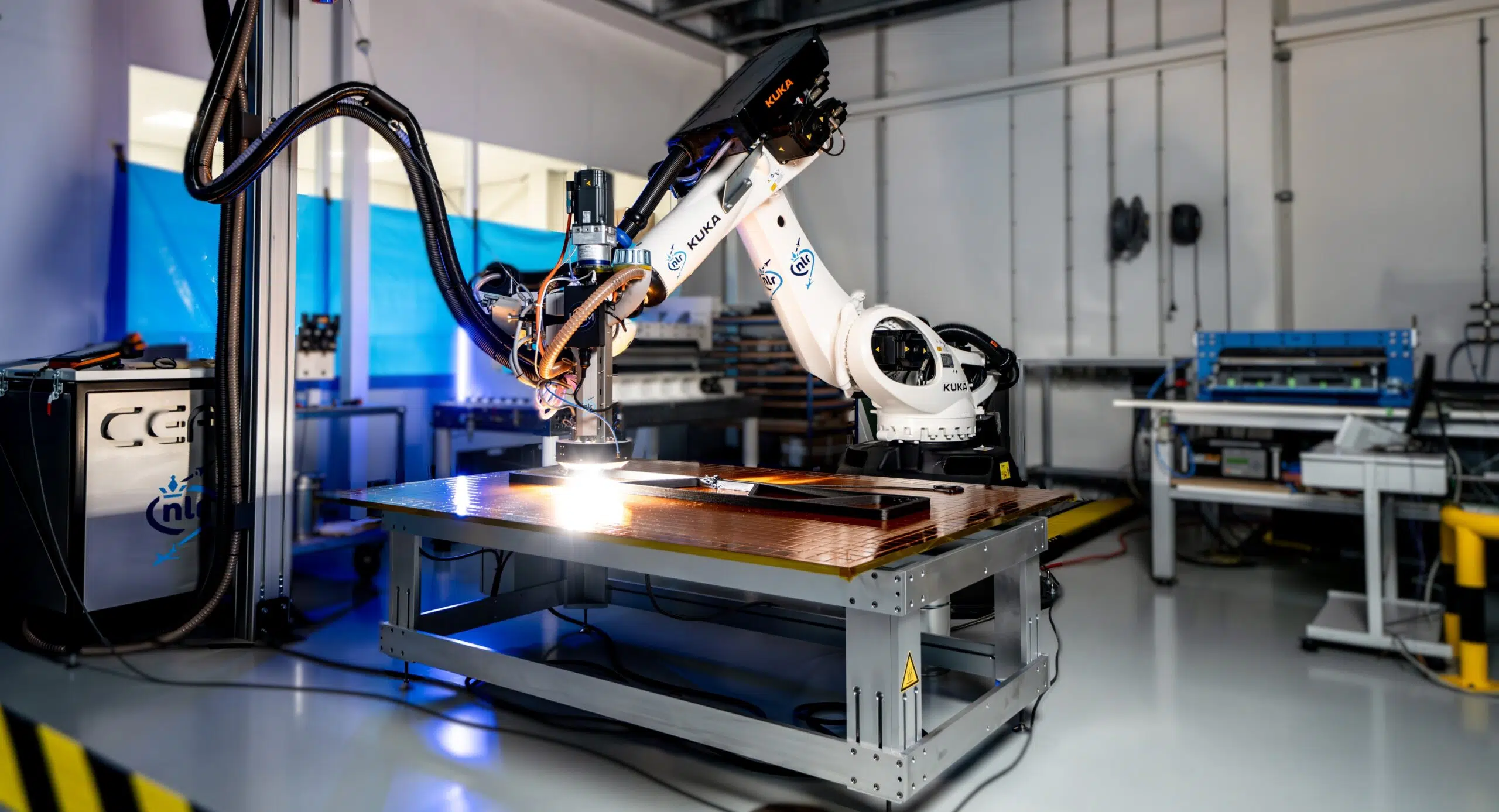
Holland High Tech has awarded a grant to a consortium of Ignarion BV and NLR for the implementation of the VLAM2 project. The objective of this project is to demonstrate the technical feasibility of the application of additive manufacturing (AM) to solid fuel rocket engines by examining both the engine housing and its interaction with the fuel. AM offers the opportunity to improve performance and reduce costs. The project focuses on building knowledge, design rules and on conducting a demonstration of an AM-produced rocket engine.
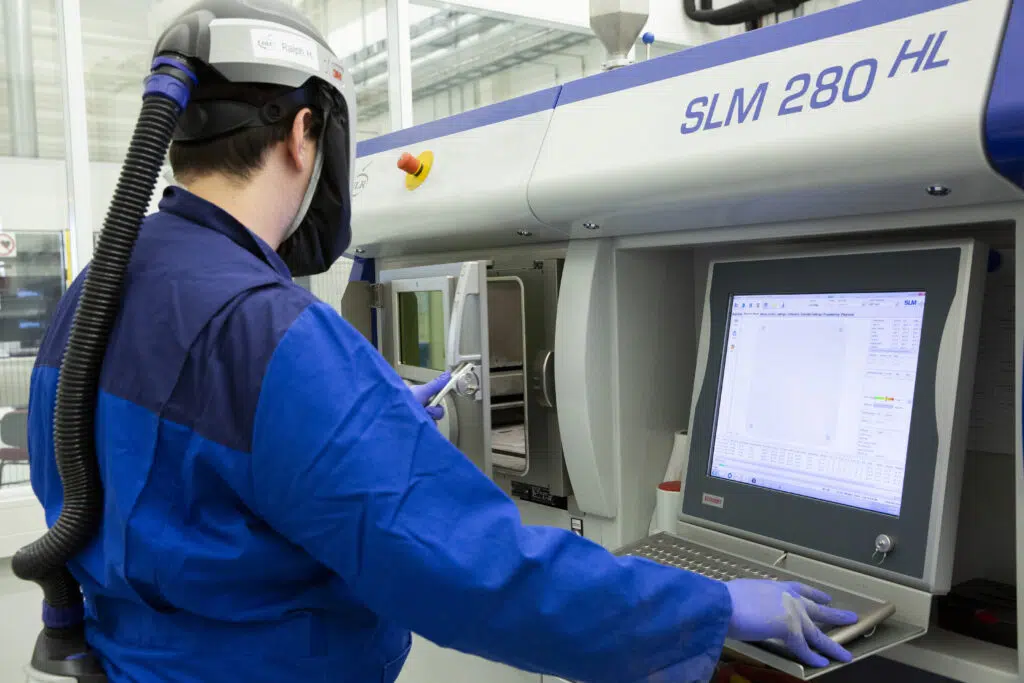
An SLM machine at NLR. SLM (selective laser melting) is one of many possible additive manufacturing technologies.
Boat hulls
In the MADAR project, the partners (NLR and the companies IMPACD Boats and Tectonic-3D) are demonstrating that marine structures – boat hulls – produced by additive manufacturing are not only quickly built, but also demonstrably reliable and militarily deployable. However, being able to print a part is not the same as proving that it is robust and reliable. The MADAR project aims to bridge that gap. To this end, the consortium will develop a validated hybrid lightweight material and the associated data-driven AM production process demonstrated on a validation platform (greater than six metres) for Defence.