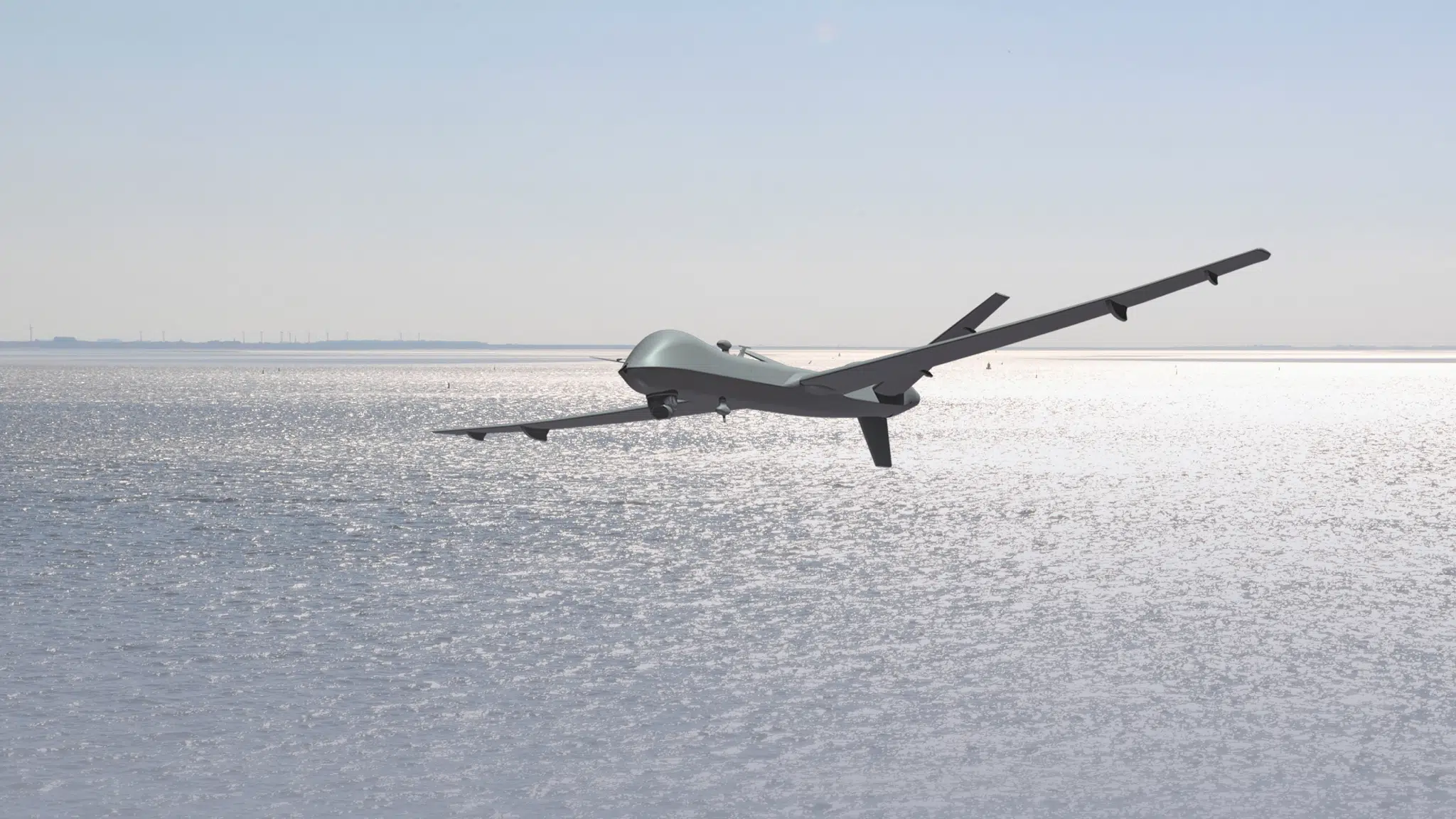
The long-term goal of the partnership between the Netherlands Aerospace Centre (NLR), Information Systems Delft (ISD) and GA-ASI is to develop the procedures needed to integrate MALE RPAS with civilian traffic in European airspace. For the purposes of this research, the MQ-9B SkyGuardian, designed and manufactured by GA-ASI, is used as an example case study. Enabling MALE RPAS to operate on a file-and-fly basis just like airliners would unlock numerous civilian applications of these new aircraft types including infrastructure inspection, search and rescue operations and quickly mapping events such as natural disasters. In order to develop and validate the required procedures meant for the real-life tests, we will first carry out large-scale simulation experiments. To this end, NLR is using two simulators, namely the NLR ATM Research Simulator (NARSIM) and the NLR Multi Unmanned aerial system Supervision Testbed (MUST). Here, NARSIM simulates air traffic and provides working positions for air traffic controllers and aircraft pilots. MUST functions as the RPAS simulator and as the ground control station the remote pilot uses to fly the RPAS. The combination of these two simulators is referred to as the MALE RPAS Real-Time Simulation Facility (MRRF).
Keeping a safe distance
One of the key challenges in integrating MALE RPAS into the airspace is to ensure that they always remain a safe distance from other traffic, even in the unlikely event that an air traffic controller fails to notice a conflict involving the RPAS. Detect and Avoid (DAA) technology makes it possible for RPAS pilots on the ground to have a clear picture of the traffic situation around their aircraft in the air. The DAA System, such as the one produced by GA-ASI, also provides alerts and guidance to resolve conflicts if they occur by performing two distinct functions. The first function is known as “remain well clear” and it enables the RPAS pilot to maintain a sufficient distance from other traffic. If a conflict situation escalates, then the second function, known as “collision avoidance”, helps the pilot to make an evasive maneuver and avoid a collision.
In November 2020, NLR performed an experiment to investigate the procedures needed to use the “remain well clear” functionality of DAA System in European airspace. The experiment involved real air traffic controllers, as well as licensed airliner and RPAS pilots. For this experiment, the MRFF simulation was equipped with GA-ASI’s Conflict Prediction and Display System (CPDS), which integrates DAA and TCAS (Traffic Collision Avoidance System) functionality, and is designed to meet the latest technical standards prescribed by RTCA for these technologies.
“The experiment considered a number of conflict scenarios in both controlled and uncontrolled airspace classes,” said Dr. ir. Emmanuel Sunil, R&D engineer and project manager at NLR. “We also considered conflicts in the Terminal Maneuvering Area (TMA), and we are one of the first in the world to test the new DAA TMA Alert (DTA) functionality specified in the RTCA DO365B technical standard using a large-scale simulation with real controllers and pilots.”
The results from the simulation will be fed back to regulators and standardisation bodies on both sides of the Atlantic to accelerate the integration of MALE RPAS. Sunil: “The actual aircraft is expected to be integrated into European airspace within the next 5-10 years depending on when the required regulations are adopted here. But it would be great if we can speedup this timeframe with evidence from our studies.”
Future Research
The partnership between Royal NLR, ISD and GA-ASI will continue into 2021, when the focus of the research will be to consider the potential interactions between the remain well clear and the collision avoidance safety layers of DAA. Additionally, next year’s simulations will demonstrate the use of the DAA traffic display to allow the remote pilot to perform the equivalent of Visual Separation procedures. This is expected to make it easier for air traffic controllers to manage RPAS with other traffic in the landing pattern.
For more information you can contact dr. ir. Emmanuel Sunil, R&D engineer and project manager at Royal NLR.