Components used in aircraft, satellites and rockets are subjected to extremely demanding conditions. They operate in environments with very high or very low pressures, severe temperature fluctuations and electromagnetic radiation, while also having to withstand intense shocks and vibrations. Before a new component can safely enter service, extensive testing is therefore required to determine whether the new system or component can survive these conditions.
NLR specialises in carrying out environmental testing. The organisation’s Vibration and Shock Test Facility in Marknesse houses several vibration testing systems.
Workmanship
During the development of new systems and components, stringent requirements are imposed to assess whether a product will withstand its intended environment. Vibration testing in particular is one of the most demanding tests, as the method of assembly often determines whether the result is successful or not. For example, a weld may appear robust to the naked eye, but that does not necessarily mean it will survive the test. In short, it is not only the product itself that is being tested, but above all the quality of the workmanship.
Test-to-failure principle
The experts at NLR in Marknesse have many years of experience in conducting vibration tests. Over the years, they have carried out hundreds of shock and vibration tests for external clients. Satellite components are also tested regularly, such as pressure sensors and thrusters (small rocket engines) for satellites. Another example is a heat exchanger produced using 3D printing technology that was subjected to testing. “During testing, cracks appeared in the material,” explains Rob Grijpma, vibration test engineer at NLR. “Thanks to that test, the design could be improved.”
NLR also performs vibration tests for the aviation sector. Examples include testing aircraft propeller blades and the ovens used to heat passenger meals on board aircraft. In some cases, the aim of the vibration test is a deliberate test-to-failure approach: vibrating a component until it breaks.
Complete satellite systems
According to Grijpma, NLR’s expertise lies in obtaining reliable measurement results. “How do we perform reliable measurements? How do we securely fasten the test object? Where should we place the sensors?”
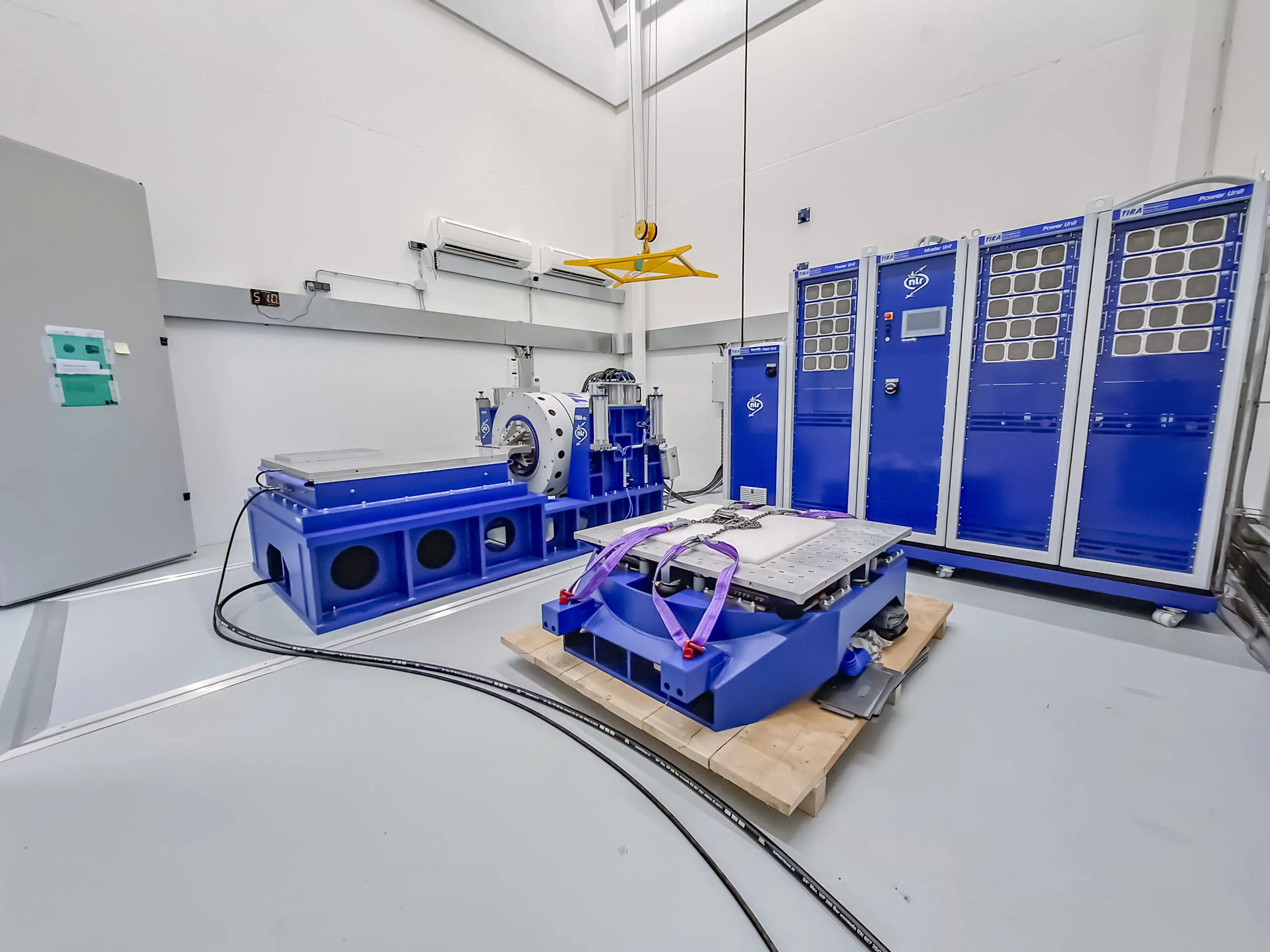
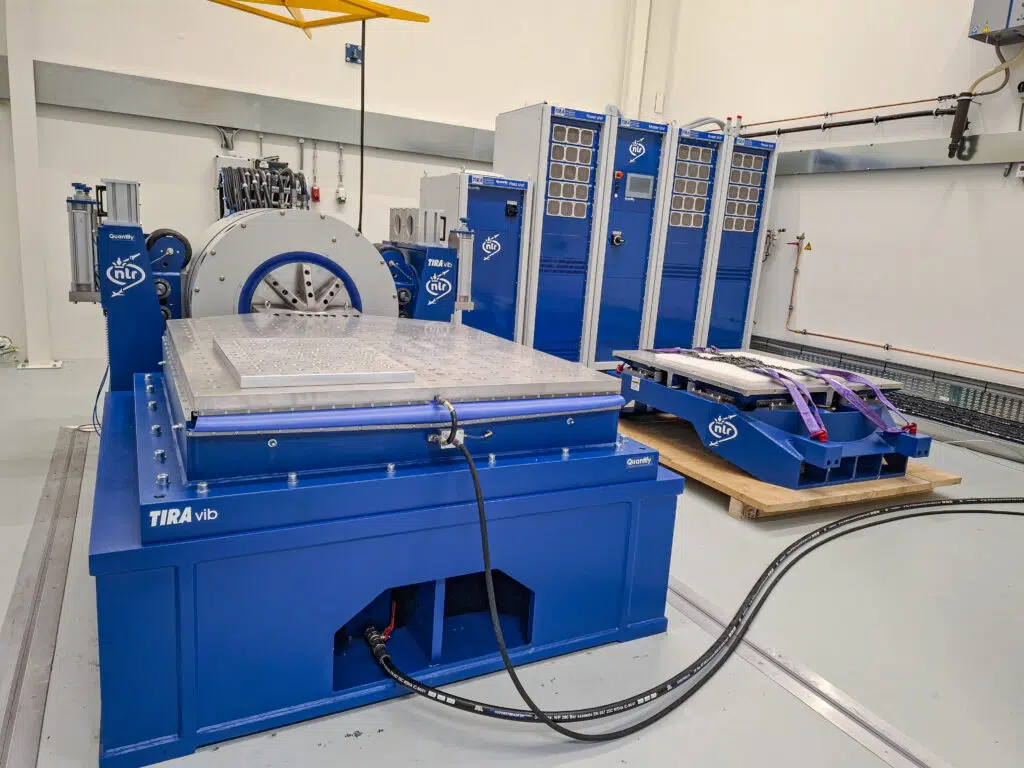
Thanks to the new shaker system, NLR is now able to test larger components and complete satellite systems for vibration resistance, as well as aircraft components under cryogenic — extremely cold — conditions. The latter is particularly relevant to the electrification of aviation, as significant research is currently underway into hydrogen-powered flight. Because these systems operate at extremely low temperatures, the testing setup also needs to become larger.
Technical specifications
The new TIRA 59412 vibration testing system features a test surface measuring 120 x 120 centimetres, onto which test components can be bolted. This is a standard size and matches the dimensions of the base plates on which satellites are mounted inside SpaceX launch vehicles.
The test platform can move horizontally with a maximum displacement of 2.5 inches (6.25 centimetres) and a maximum acceleration of 30 g. The shaker can subject a test object to different forms of vibration, ranging from highly regular sinusoidal vibrations to the random shocks experienced during a rocket launch.
See also: homepage of the Vibration and Shock Test Facility.