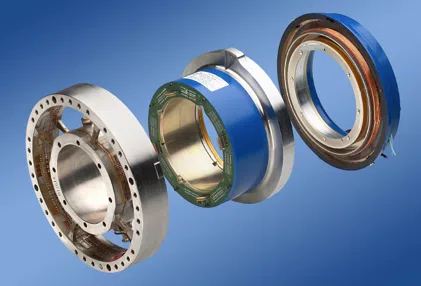
The invention occurred under the auspices of Clean Sky, the European Joint Technology Initiative, in which Airbus is developing an Open Rotor Engine for passenger aircraft. The Contra-Rotating Open Rotor (CROR) concept features two rotors. These rotate in opposite directions, resulting in substantial fuel savings. A specific point of attention for the Open Rotor is the noise produced by the rotors. As part of a CROR wind tunnel model, NLR developed a special telemetry unit, which is an advanced system that is part of the rotors and enables contactless transfer of pressure, force and temperature data.
The patent application is for an invention that is part of this measurement system (the telemetry unit), which NLR also built. This unit has a maximum rotational speed of 8400 RPM. The electronics are able to tolerate static acceleration up 5,500 times the force of gravity. The design of the system ensures that the structure remains intact and continues functioning properly at such high speeds.
Transfer
The invention for which NLR has applied for a patent performs three functions:
– The transfer of electrical power in order to conduct measurements in the rotating components.
– The transfer of a sample clock from the stator to the rotor.
– Also the transfer of measurement data with a wide bandwidth from the rotor to the stator. One hundred Mbit/s can be transferred.
The three functions must be performed without mechanical contact occurring between the stationary component (the stator) and the rotating component (the rotor). Traditional solutions using slip rings cannot be reliably applied at high rotational speeds. But with this new invention, the NLR can now achieve this.
Further development
In response to a request by Airbus, the system’s capability was further improved after the patent application was submitted. In a significant design effort, the data rate was increased to make it compatible with larger numbers of sensors and higher sample rates. This ‘successor’ was designed, manufactured and demonstrated with a 1 Gigabit/s data rate.
European Patent Office
NLR engineers have been engaged in the patent application process since July 2012. In July 2014, the European Patent Office ruled that the invention was ‘new and inventive with respect to state-of-the-art technology’ and can therefore be patented. In January 2015, NLR filed patent applications in Europe, Canada and the United States.